
Tolle Ware zu einem unschlagbaren Preis (inkl. Versand). Abwicklung schnell und unkompliziert. Weiter so!
View on GoogleCompact loaders: articulated loaders, track-type loaders or compact wheel loaders – which one is right for you?
02/11/2026
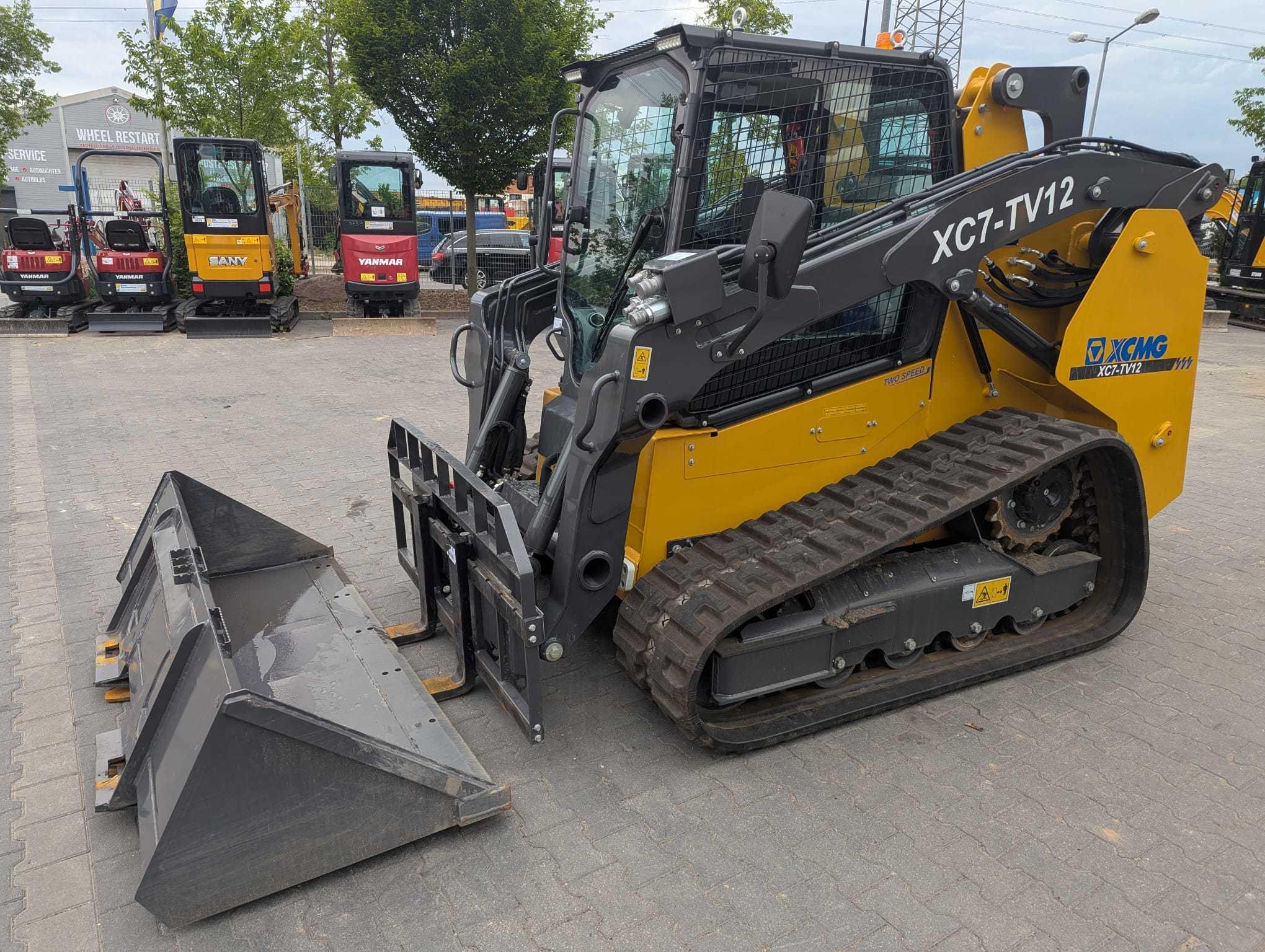
Whether on the farm, in gardening and landscaping, or on a building site: small loaders are the workhorses that are in constant use every day. But not all ‘compact loaders’ are the same. A Bobcat with side steering operates quite differently from an articulated farm loader or a compact wheel loader with all-wheel steering – and a tracked loader has its own unique strengths. We explain the different designs, what tipping load and payload really mean, what driving licence you need, and what to look out for when buying second-hand.
An overview of the four types
- Compact loader with side steering (skid-steer): Rigid frame; steering works in the same way as on a tracked vehicle, using different rotation speeds on the left and right. Extremely manoeuvrable, turns on the spot, ideal for confined construction sites and demolition work. The Bobcat is a classic example.
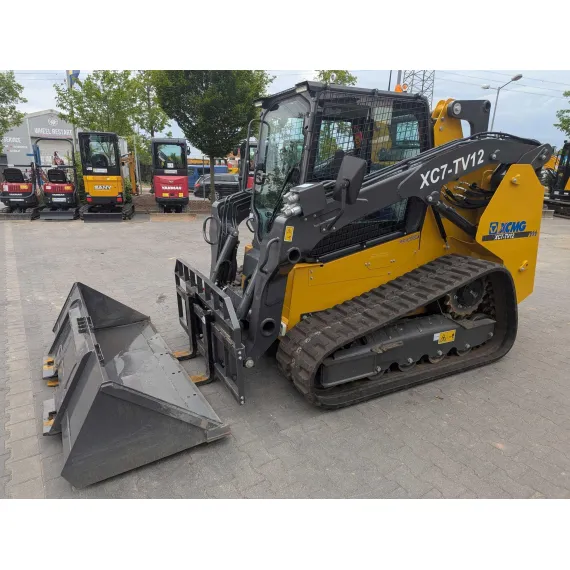
- Compact track loader: Same principle, but on rubber tracks. Greater traction and lower ground pressure – according to the data sheet, the Bobcat T450 achieves 34 kPa. An advantage on wet, soft ground; on firm, dry ground, the wheeled version is, according to Bobcat, faster and more economical to operate.
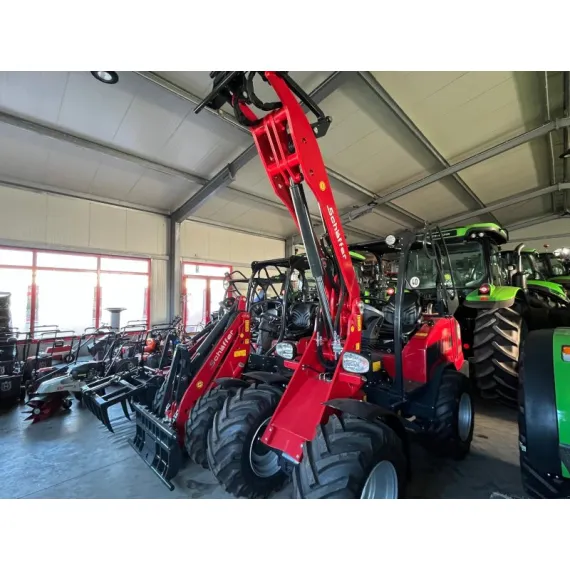
- Articulated farm and compact loaders: The front and rear sections are connected via an articulated joint. This protects the ground and lawn, and the machine travels more smoothly and quickly. Typically used in agriculture and landscaping – Schäffer, Weidemann, Avant or the small Yanmar wheel loaders.
- Compact wheel loaders with all-wheel steering: Rigid frame, all four wheels steer. High stability even when the steering is turned to the full, as the centre of gravity does not shift. Typical example: Kramer.
A fifth variant comprises telescopic and farm loaders with a telescopic arm, which can stack higher and reach further – they are worth a separate comparison.
Tipping load, payload, rated load: what the figures mean
The tipping load is the load at which the machine tips forwards. You must not carry out work with the machine at this load. The decisive factor is the payload or rated load, which is derived from this – and this is where the different designs differ significantly:
| Model | Rated load | Example (manufacturer’s specifications) |
|---|---|---|
| Wheeled compact loader | 50 per cent of the tipping load | Bobcat S450: tipping load 1,308 kg, rated load approx. 654 kg |
| Compact track loader | 35 per cent of the tipping load | Bobcat T450: tipping load 2,049 kg, rated load 717 kg |
| Articulated loader / farm loader | Tipping load specified for both straight and articulated positions – the articulated value applies | Weidemann Hoftrac 1140: with the boom articulated, approximately 25 per cent less than with the boom extended |
| Compact wheel loaders with forks | Payload according to EN 474-3; according to manufacturer’s specifications, this is often 80 per cent (on level ground) or 60 per cent (on uneven ground) of the tipping load | Kramer 5035: tipping load with pallet fork 930 kg; at 80%, this equates to a payload of around 740 kg on level ground |
Therefore, never compare the tipping load of a crawler loader with that of an articulated loader. Ask for the rated load in your working position – and, for an articulated loader, the value when the boom is articulated.
Driving licence, registration number, training
- Registration: Self-propelled machinery is exempt from registration. Up to 20 km/h, a sign bearing the owner’s name and address is sufficient; above that speed, the machine requires a number plate. An operating licence is still required, however.
- Driving licence: Category L applies to self-propelled machinery up to 25 km/h – without being restricted to agricultural use; it is included in the Category B car driving licence. Category T permits speeds of up to 40 km/h, but only when used for agricultural or forestry purposes. Faster machines require Class B (up to 3.5 t), C1 (up to 7.5 t) or C, depending on their authorised gross vehicle weight.
- No goods transport: According to the DGUV, wheel loaders must not be used to transport goods on public roads.
- Driver: According to DGUV Rule 100-500, the driver must be at least 18 years old, suitable and trained, have demonstrated their competence, and be authorised by the employer – preferably in writing. Seat belts are compulsory for machines fitted with roll-over protection.
Which model for which application?
- Confined building sites, demolition, indoor spaces: compact loaders with side steering or track-type loaders – manoeuvrable and compact.
- Soft, wet ground, earthworks, levelling: compact track loaders. More traction, less ground pressure.
- Lawn, paving, yard areas: articulated loaders or compact wheel loaders. Tracks and side-steering wheels can damage sensitive surfaces.
- Stables, farmyards, feed and bedding: Articulated farm loader with a low profile and good visibility.
- Frequent travel between job sites: articulated or compact wheel loaders with speeds of 20 km/h or more; compact loaders with side-steering usually only travel at around 10 to 14 km/h.
One cost factor that many people underestimate: wear and tear on tyres and rubber tracks. Ask about their condition and factor the cost of replacement into your calculations.
Checklist for buying second-hand
- Warm-up: Only assess the hydrostatic drive system after around 10 minutes of operation. Does the machine hesitate when starting off or changing direction?
- Lifting and tipping cycles: Lift, tip and hold several times. Levers must return smoothly to neutral; cylinders must not sag.
- Pins and bushings: Check for play on the lift arm, tilt cylinder and quick-change coupler; inspect the lift arm and frame for cracks.
- Articulation joint: On an articulated loader, check the joint for play – move the steering back and forth whilst stationary and observe.
- Undercarriage on a crawler loader: Sharp teeth on the drive wheel, grooves in the idler wheel and play in the track rollers indicate wear; check the tracks for cracks, cuts and remaining tread depth.
- Hydraulics: Check for leaks in hoses and cylinders, and verify the function of the auxiliary hydraulics for attachments.
- Documentation: Operating hours, maintenance records and, where required, the type-approval certificate or data sheet stating the maximum speed.
Where to look
On machinery-market.eu you’ll find all four types:
- Compact track loaders: XCMG XC7-TV12 (new), Bobcat T770 (new), Bobcat T450 (new)
- Compact skid-steer loaders: Bobcat 773, Gehl skid-steer loader
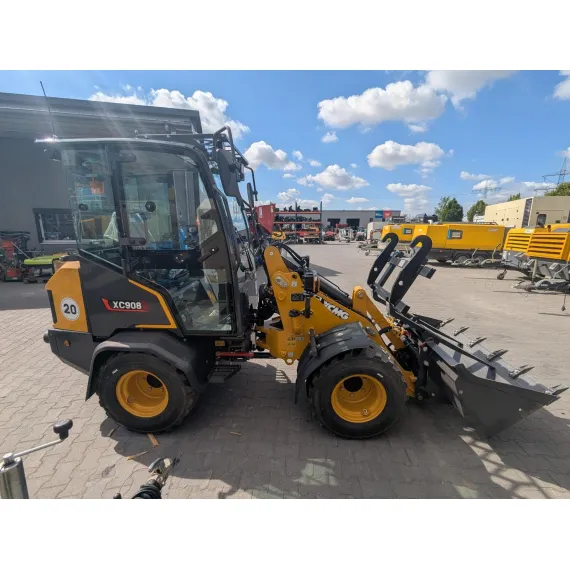
- Articulated yard and compact loaders: Schäffer 3650 and Schäffer 1622 (new), Weidemann 1390, XCMG XC908 (new), Yanmar V80 and Yanmar V100, Caterpillar 906M and 908M
- Compact wheel loaders with all-wheel steering: Kramer 5035 and Kramer 5075
You can find further machines in the categories ‘Compact loaders’, ‘Wheel loaders’ and ‘Telescopic handlers’.
Frequently asked questions
What is the difference between a compact loader and a farm loader?
A compact loader, in the strict sense, has a rigid frame and is steered by varying the wheel speeds on the left and right (side steering). A farm loader has an articulated design: the front and rear sections are connected by a joint. This protects the ground and lawn and allows for higher speeds.
What is the rated load in relation to the tipping load?
For wheeled skid steer loaders, the rated load is 50 per cent of the tipping load; for compact track loaders, it is 35 per cent. For articulated loaders, manufacturers specify the tipping load both in the straight and articulated positions – in practice, the articulated value is the one that counts.
What driving licence do I need for a wheel loader?
For self-propelled machinery up to 25 km/h, a Class L licence is sufficient. A Class T licence permits speeds of up to 40 km/h, but is only valid for agricultural or forestry purposes. For faster machines, the licence category depends on the maximum authorised mass: up to 3.5 t – Category B; up to 7.5 t – Category C1; above that – Category C.
Does a skid-steer loader need a number plate?
Self-propelled work machines do not require registration. For machines with a maximum design speed of up to 20 km/h, a sign bearing the owner’s name and address is sufficient; above this speed, a number plate is compulsory.
Track loader or wheel loader – which is better?
On soft, wet ground and for earthworks, the track loader offers more traction and exerts less ground pressure. On firm ground, on grass and paving, and when travelling long distances, the wheel loader is faster, gentler on the ground and cheaper to run.
Sources
- Bobcat – Technical specifications for the T450 and S450
- Bobcat – Compact track loaders for soft ground (buying guide)
- Weidemann – Hoftrac 1140 data sheet
- Kramer – Data sheet for the 5035 wheel loader
- Driving Licence Regulations (gesetze-im-internet.de) – Section 6: Driving Licence Categories
- Vehicle Registration Regulations (gesetze-im-internet.de) – Section 4: Vehicles Exempt from Registration
- DGUV Construction Division – FAQs on Earthworks and Road Construction
- DGUV Rule 100-500, Chapter 2.12 – Earth-moving machinery
All links accessed on 21 October 2026.
Comments
No posts found
Write a reviewRecent posts
- Compact loaders: articulated loaders, track-type loaders or compact wheel loaders – which one is right for you?
- SANY 2026: Electric excavators, new models – and what this means for buyers in Europe
- Fertiliser spreaders: boundary spreading, section control and the requirements of the Fertiliser Ordinance
What customers say about these vendors
4.5
140 reviews
GSK Baumaschinen
All reviews on Google · Write a review
Ich war auf Ebay Kleinanzeigen auf der suche nach einen Minibagger und hatte / habe Interesse an einen Bobcat E10 davon hat die Firma einige im Angebot :-))) Zur Zeit ist nicht das richtige für meine Zwecke dabei, aber ich muss sagen ich wurde sehr nett und Kompetent beraten, und man hat mir versucht so gut es ging weiter zu helfen und das ob wohl ich nicht gekauft habe . Die Antworten kamen sehr schnell Danke und macht weiter so ich besuche eure Webseite wieder Schöne Grüße aus dem Norden von der Ostsee Jens Köpke
View on GoogleNachdem unser Eigenheim im Ahrtal sehr stark beschädigt war, wurde uns angeboten die Balken mit Eisbestrahlung zu behandeln. (- komplett kostenlos!) Super netter Kerl, der ne klasse Arbeit macht. Über die Hilfe sind wir extrem dankbar, denn bei anderen Firmen ist das nicht selbstverständlich. Vielen Dank nochmal dafür! 👍👍👍
View on GoogleSehr gute und fachliche Beratung.Auch nach dem Kauf ist Herr Schrenk immer gerne Ansprechpartner und kümmert sich auch um Sachen um die er sich eigentlich nicht kümmern muss. Sehr zuverlässiger Partner und immer für seine Kunden da. Ich kann nur sagen: Herr Schrenk... weiter so👍 Gruß Frank Stein Weststrahl
View on Google
Gastro Gigant
All reviews on Google · Write a review
Seit 3 Jahren habe ich meinen Schnitzelmaster täglich im Einsatz und es ist immer wieder eine Freude damit zu arbeiten!!!!
View on GoogleGroße Auswahl, vernünftige Preise, toller Service – was will man mehr?
View on GoogleSchnelle und korrekt Lieferung. Top so wie es sein soll. Gerne wieder!
View on GoogleHab vor einer Woche einen Backofen gekauft total zufrieden vom Service und Aufbau danke und sehr freundlich 😊
View on GoogleSehr nettes Personal. Hat mir mit einer Spülmaschinen Haube weitergeholfen. Einfach nur Klasse. Weiterempfehlung!
View on Google
Kraus Baumaschinen GmbH
All reviews on Google · Write a review
Top Service von Anfang bis Ende! Unser Kompressor hatte einen Schaden und wir haben uns an Kraus Baumaschinen gewendet. Der Chef, Marius Kraus, hat sich persönlich um die Koordination gekümmert – Teile wurden zügig bestellt und alles klar abgestimmt. Als der Monteur dann vor Ort war, lief alles reibungslos: freundlich, kompetent und richtig effizient. Die Reparatur wurde sauber und schnell erledigt. Dazu faire Stundensätze und vernünftige Anfahrtspreise – so macht Service Spaß. Klare Empfehlung! Grüße GSK Baumaschinen
View on GoogleSehr kompetente, freundliche Mitarbeiter, selbst als Frau wirst du professionell beraten. Vielen Dank für die unkomplizierte Art und Weise🥰
View on GoogleSehr zuverlässiges und professionelles Unternehmen. Kompetente Beratung, freundliche Mitarbeiter und eine unkomplizierte Abwicklung. Absprachen werden eingehalten und die Zusammenarbeit funktioniert immer bestens. Klare Empfehlung!“ ⭐⭐⭐⭐⭐
View on GoogleDirekt nach der Ankunft in Empfang genommen worden. Alles aufgenommen...perfekt...auch per Email oder telefonisch sehr kompetente Beratung und Betreuung
View on GoogleHow we display the reviews
Shown: up to 5 reviews per profile from the selection supplied by Google, newest first. Only reviews with at least 4 stars are listed. Reviews without text are not listed. Overall rating and number include all Google reviews of the profiles listed.
The reviews come from Google Maps. We do not check whether the reviewers actually bought or used the goods or services reviewed.
As of: 22.11.2026