
- Construction machinery
- Agricultural machinery
- Food technology
- Transport vehicles & commercial vehicles
- Metalworking machines & machine tools
- Woodworking machines
- Forklift trucks & industrial trucks
- Automation technology
- Conveyor & drive technology
- Storage technology
- Printing machines & printing presses
- Plastics processing & plastics technology
- Recycling & disposal machines
- Packaging machines
- Compressed air technology
- Measurement & testing technology
- Energy technology
- Chemical & pharmaceutical machines
- Municipal technology
- Cleaning technology
- Process engineering
- Refrigeration technology
- Medical technology
- Glass processing & ceramic processing
- Vacuum technology
- Surface technology
- Motors
- Surplus stock & remaining stock
- Wire processing machines
- Paper processing & film processing
- Textile machinery
- Filling systems & filling technology
- Special machines
- Other machines
- Power tools
- Automotive workshop equipment
- Stone working machines
- Office technology
- Purification technology
- Mail processing machines
- Telecommunications technology & computer technology
Fertiliser spreaders: boundary spreading, section control and the requirements of the Fertiliser Ordinance
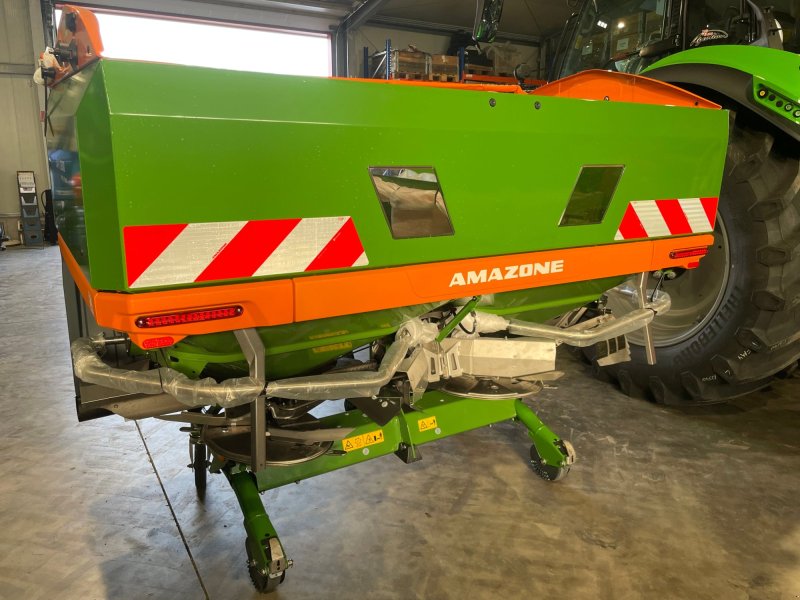
A fertiliser spreader looks rather unremarkable: a hopper, two discs, a couple of blades. Yet every year, it determines whether a significant amount of money is saved – and whether the farm complies with the Fertiliser Ordinance. Even minor spreading errors cost yield, without being visible in the crop. We explain what the Fertiliser Ordinance requires in terms of technology, the benefits of boundary spreading, section control and weighing technology, and what you should look out for when buying a second-hand spreader.
What the Fertiliser Ordinance requires at the field edge
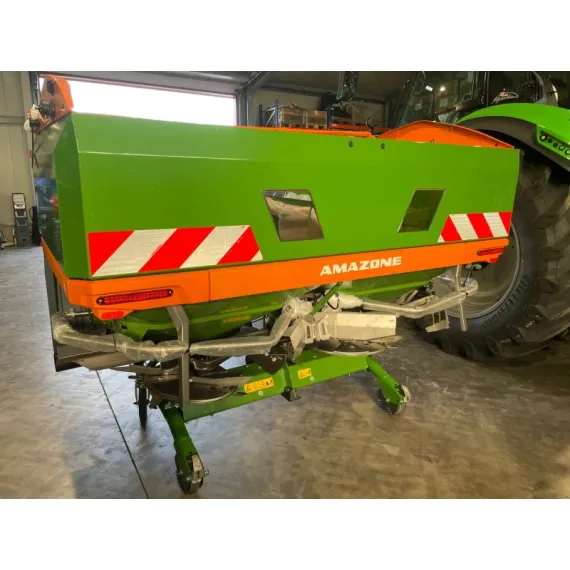 Amazone ZA-V 2600, new, year of manufacture 2025 · view listing
The most important technical requirement is set out in Section 5 of the Fertiliser Ordinance: there must always be a minimum distance of 4 metres between the spreading area and the top of the embankment bordering a body of water. This distance is reduced to 1 metre if the spreader is fitted with a boundary spreading device or if the spreading width and working width are identical. Under no circumstances may fertiliser be applied within 1 metre of the water body.
The rules are stricter on slopes: from a gradient of 5 per cent, a 3-metre strip is off-limits; from 10 per cent, 5 metres; and from 15 per cent, 10 metres. Additional requirements apply in the adjacent zones, such as immediate incorporation on uncultivated land. The relaxation to 1 metre permitted by the boundary spreading device therefore only applies on flat land.
In addition, there are the restricted periods under Section 6: on arable land, no nitrogen fertiliser may be applied after the harvest of the last main crop until 31 January. Exceptions until 1 October apply to catch crops, winter rapeseed and field fodder (sown by 15 September) as well as winter barley following a cereal crop (sown by 1 October) – within the limits of the fertiliser requirement and up to a maximum of 30 kg of ammonium-N or 60 kg of total N per hectare. On grassland, the ban applies from 1 November to 31 January. Furthermore, solid manure from hoofed or cloven-hoofed animals, compost and phosphate-containing fertilisers may generally not be applied from 1 December to 15 January. Fertilisation is generally prohibited on flooded, water-saturated, frozen or snow-covered soil.
Red zones and the Fertiliser Act: the situation as at October 2026
There are significant developments regarding nitrate-contaminated ‘red zones’. Following a ruling by the Federal Administrative Court on 24 October 2025 regarding the Bavarian designation, several federal states have repealed their state regulations or ‘red zones’; the remaining states have suspended checks and sanctions relating to the additional requirements. In June 2026, the Federal Ministry of Agriculture presented a draft for a new, legally sound designation. The Material Flow Balance Ordinance was repealed in 2025, and the amendment to the Fertiliser Act is currently being debated in the Bundestag. Important: The general rules of the Federal Fertiliser Ordinance – determination of requirements, waiting periods, distances from water bodies – remain unchanged. Please check with the relevant Chamber of Agriculture or State Office for the current status regarding your land.
Border spreading, edge spreading, ditch spreading – what is the difference?
| Methods | When | Objective |
|---|---|---|
| Edge spreading (yield-oriented) | The neighbouring field is also arable or grassland | Full application right up to the edge; a small amount of fertiliser may spill over the boundary |
| Boundary spreading (environmentally focused) | Path, road, watercourse, neighbouring plot | Nothing beyond the boundary; the edge strip is slightly under-fertilised |
| Spreading into ditches | Watercourses at the edge of the field | Spread at a greater distance to ensure nothing enters the water |
A comparison by top agrar (2022) illustrates just how significant the difference is: without a boundary spreading device, only around half the target amount reaches the field edge, and around 17 per cent of the total amount ends up beyond the boundary. Simpler systems such as the lamella block or hydraulic boundary spreading reduce loss beyond the boundary to around 2.5 per cent at a working width of 18 metres, whilst Amazone’s AutoTS and BorderTS reduce it to under 1 per cent – at 36 metres, these two systems maintain the target application rate right up to the boundary. According to the report, expensive systems are particularly cost-effective on small-scale plots and with large working widths.
Section Control, weighing technology and spread pattern control
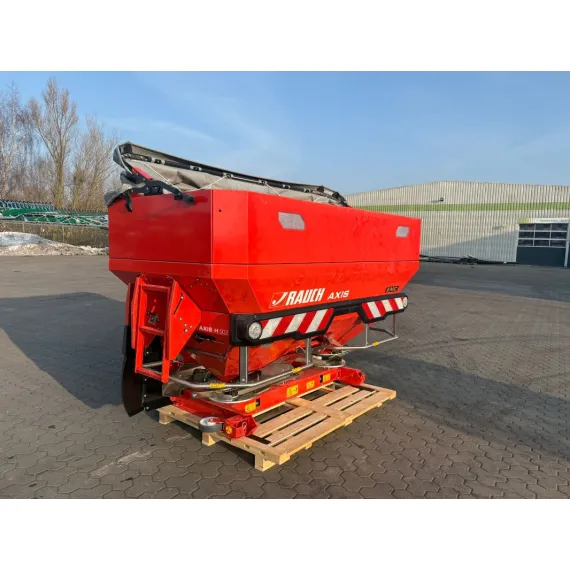 Rauch AXIS H 50.2 EMC + W with mass flow control and weighing system · view listing
- Section Control: The on-board computer uses GPS to adjust the spread width and rate for wedges, headlands and overlaps. Better systems also shift the feed point on the disc to achieve this. Manufacturers’ figures for fertiliser savings are usually in the range of 5 to 10 per cent – independent measurements are rare, and the actual savings depend heavily on the shape of the field.
- Weighing technology: Load cells continuously measure the hopper contents and automatically adjust the application rate. This compensates for fluctuations in fertiliser quality.
- Mass flow control: In EMC spreaders, Rauch’s system measures and controls the application rate separately on the left and right in real time. Amazone’s ArgusTwin monitors the lateral distribution for each disc via 14 radar sensors and automatically adjusts the application rate.
- Wind compensation: Systems such as Amazone’s WindControl compensate for crosswinds – this is important because urea, for example, becomes problematic at wind speeds of around 4 m/s.
Working widths have increased significantly in recent years: Amazone specifies up to 36 m for the ZA-V and up to 54 m for the ZA-TS; Rauch specifies up to 56 m for the AXIS H 55 EMC+W. But be careful: According to the Saxony State Office, the lateral distribution of centrifugal spreaders quickly reaches its limits beyond 24 m, and according to the DLG, even distribution is practically impossible beyond 30 m for fertilisers with a high proportion of fine particles and dust. Large working widths require good-quality fertiliser and regular monitoring.
Spreading quality: Why the settings are more important than the working width
The measure of uniformity is the coefficient of variation (CV) of the lateral distribution. The DLG considers a CV of up to 15 per cent to be acceptable. In practice, a large proportion exceeds this: according to empirical data from DEULA Nienburg, as reported by Yara, around 70 per cent of mineral fertiliser applications using centrifugal spreaders in Germany have a CV exceeding 12 per cent. The tricky thing, according to the Saxony State Office, is that errors with a CV below 20 per cent are often not visible in the crop, yet they still reduce yield. From around 20 per cent, streaks become visible.
The most common causes are worn or incorrectly adjusted spreading vanes, metering slides that open unevenly, incorrect PTO speed, incorrect mounting height and uneven tyre pressure. This can be remedied by carrying out a check using test trays or mats (such as Amazone’s EasyCheck or Rauch’s XCheck) – ideally with every new batch of fertiliser.
Good to know: There is no statutory testing requirement for fertiliser spreaders used solely for fertiliser. However, as soon as plant protection products are applied – such as slug pellets – the machine must be tested regularly in the same way as a plant protection sprayer and must display a test sticker.
Checklist for second-hand fertiliser spreaders
- Spreading vanes: Wavy, bent or worn-down vanes are worn out and impair the spread pattern.
- Spreading discs and gearbox: The scales must be legible. Vertical play or wobbling indicates bearing wear. The gearbox oil should be clear, not brown or cloudy.
- Dosing slides: Both sides must open to the same extent; for hydraulic slides, check the closing springs.
- Agitator: A damaged agitator alters the flow rate.
- Corrosion: Fertiliser corrodes steel. Check the frame and hopper connection for rust and cracks; faded plastic indicates outdoor storage.
- Electronics: For weighing and ISOBUS spreaders, have the terminal, load cells and Section Control tested whilst the machine is stationary. Ask which activation codes are specific to the machine.
- Test kit: Ideally, buy one that includes test trays or mats – this will allow you to check the lateral distribution yourself.
Where to look
On machinery-market.eu you’ll currently find fertiliser spreaders from Amazone and Rauch – both new and used. New at Petri & Söhne: the Amazone ZA-V 2600 and the Amazone ZA-XW 503 for smaller farms. Second-hand models include, for example, the Amazone ZA-M 1500 Profi S. Mecklenburger Landtechnik stocks large weighing spreaders such as the Rauch AXIS H 50.2 EMC + W, the Rauch AXIS 50.2 H EMC+W with VariSpread pro, ISOBUS and Axmat duo, as well as the Amazone ZA-M Ultra 3000.
You’ll find the right tractor in our tractors section – and in our guides you can read about what to look out for when buying a second-hand tractor and when a plough is still worth the investment.
Frequently asked questions
What distance must I maintain from water bodies when spreading fertiliser?
According to Section 5 of the Fertiliser Ordinance, the general rule is 4 metres from the top of the embankment. With a boundary spreading device, or if the spreading width and working width are identical, 1 metre is sufficient – but only on flat ground. On slopes with a gradient of 5 per cent or more, greater distances of 3, 5 or 10 metres apply.
Until when am I allowed to spread nitrogen in the autumn?
On arable land, there is a closed period until 31 January following the harvest of the last main crop. Exceptions until 1 October apply to catch crops, winter rapeseed, field fodder and winter barley following a cereal crop, with a maximum of 30 kg of ammonium nitrogen or 60 kg of total nitrogen per hectare. On grassland, the closed period runs from 1 November to 31 January.
What is the difference between boundary spreading and edge spreading?
With boundary spreading (yield-oriented), some fertiliser may cross the boundary because there is also agricultural land adjacent to it. With boundary spreading (environment-oriented), nothing crosses the boundary – for example, near paths or watercourses – but the boundary strip is slightly under-fertilised as a result.
Does a fertiliser spreader need to undergo an equipment inspection?
No, there is no legal requirement for inspection for fertiliser spreaders used solely for that purpose. However, if the machine is used to apply plant protection products such as slug pellets, it is subject to inspection and requires an inspection sticker.
What is a good coefficient of variation for a fertiliser spreader?
The DLG states that a coefficient of variation (CV) for lateral distribution of up to 15 per cent is acceptable. Spreading errors of less than 20 per cent are often not visible in the crop, but still reduce yield – which is why it is worth carrying out regular checks using test trays or mats.
Sources
- Fertiliser Ordinance (gesetze-im-internet.de) – Section 5: Distances from water bodies and slope gradients
- Fertiliser Ordinance (gesetze-im-internet.de) – Section 6: Withholding periods
- German Bundestag – Amendment to the Fertiliser Act (2026)
- top agrar – Red zones: Status in the federal states (March 2026)
- top agrar – Comparison of boundary spreading equipment (2022)
- DLG – Mineral fertilisers: Appearance matters too (DLG-Kompakt 5/2024)
- LfULG Saxony – Optimising fertiliser spreader settings (Agricultural Technical Information, 2021)
- TLLLR Thuringia – Plant protection equipment testing of granular spreaders
Manufacturers’ specifications on working widths and control systems: Amazone and Rauch. All links accessed on 21 October 2026.
No posts found
Write a reviewRecent posts
- Fertiliser spreaders: boundary spreading, section control and the requirements of the Fertiliser Ordinance
- Ploughing or cultivating in autumn? When is it still worth using tillage methods that turn the soil over?
- Buying a second-hand tractor: What really matters when it comes to continuously variable transmission (CVT) tractors
machinery-market.eu
The European marketplace for new and used machinery, commercial vehicles and industrial equipment.
Would you like to enquire about a machine?
Please contact the seller directly via the enquiry form in the listing or via the seller profile.
© 2025 - 2026 machinery-market.eu.
machinery-market.eu — the European online marketplace for used and new machinery. On our B2B platform, you’ll find thousands of verified listings from commercial sellers across Europe in the fields of construction equipment, agricultural machinery, food processing equipment, commercial vehicles, machine tools, and specialty equipment.
Our marketplace includes the following machinery and equipment categories, among others: Excavators, mini excavators, mobile excavators, crawler excavators, compact excavators, track excavators, wheel loaders, skid-steer loaders, farm loaders, telescopic loaders, dump trucks, articulated dump trucks, articulated trucks, rollers, tandem rollers, trench rollers, vibratory plates, rammers, compaction equipment, construction compressors, power generators, light towers, aerial work platforms, scissor lifts, telescopic work platforms, forklifts, forklifts, electric forklifts, container handlers, demolition excavators, demolition hammers, drilling rigs, earth rockets, pipe layers, plow layers, snow groomers, high-pressure cleaners, dry ice blasting machines, sandblasting systems, cleaning technology.
In the field of agricultural machinery and forestry equipment: tractors, combine harvesters, forage harvesters, balers, round balers, square balers, plows, cultivators, harrows, seeders, drillers, fertilizer spreaders, field sprayers, crop protection sprayers, trailers, dump trucks, silo trucks, slurry tankers, manure spreaders, front loaders, rear loaders, wood splitters, harvesters, forwarders, forestry mulchers, sawmill machinery, wood chippers, planers.
In the field of food and packaging technology: Packaging machines, labeling machines, filling systems, bottle fillers, conveyor belts, refrigeration systems, freezing systems, baking ovens, deck ovens, cutting machines, kneading machines, dough dividers, mixers, vacuum packaging machines, shrink tunnels, palletizers, robotic cells, CIP systems, pasteurizers.
In the field of machine tools, CNC, and metalworking: CNC lathes, CNC milling machines, machining centers, 5-axis machines, turning centers, grinding machines, cylindrical grinders, surface grinders, drilling machines, column drills, sawing machines, band saws, plasma cutters, laser cutting systems, waterjet systems, press brakes, shear machines, edge grinders, welding robots, robotic cells, 3D printers, generators.
In the commercial vehicles and transport sector: trucks, tractor-trailers, semi-trailers, trailers, low-loaders, dump trucks, refrigerated trucks, garbage trucks, vacuum excavators, vacuum trucks, flatbed trucks, box trucks, pickups, flatbed tarps, containers, swap bodies, roll-off dumpers, skip loaders, water trucks, spray trucks.
We facilitate business transactions in the following sectors: civil engineering, building construction, road construction, earthworks, demolition, recycling, landscaping, gardening and landscaping, agriculture and forestry, logistics, industry, metal construction, wood processing, food production, food processing, packaging industry, printing industry, pharmaceutical industry, construction companies, equipment rental, rental parks, workshop supplies, and blow-in technology.
Our listings reach buyers and sellers from Germany, including the following cities and regions: Berlin, Hamburg, Munich, Cologne, Frankfurt am Main, Stuttgart, Düsseldorf, Leipzig, Dortmund, Essen, Bremen, Dresden, Hanover, Nuremberg, Duisburg, Bochum, Wuppertal, Bielefeld, Bonn, Münster, Karlsruhe, Mannheim, Augsburg, Wiesbaden, Mönchengladbach, Gelsenkirchen, Aachen, Braunschweig, Chemnitz, Kiel, Halle (Saale), Magdeburg, Krefeld, Freiburg im Breisgau, Lübeck, Mainz, Erfurt, Oberhausen, Rostock, Kassel, Hagen, Saarbrücken, Hamm, Mülheim an der Ruhr, Ludwigshafen, Leverkusen, Oldenburg, Osnabrück, Solingen, Heidelberg, Herne, Neuss, Regensburg, Darmstadt, Paderborn, Würzburg, Ingolstadt, Heilbronn, Pforzheim, Göttingen, Bottrop, Reutlingen, Koblenz, Bremerhaven, Recklinghausen, Bergisch Gladbach, Jena, Trier, Erlangen, Moers, Siegen, Hildesheim, Salzgitter, Cottbus, Speyer, Hanhofen, Frankenthal, Kaiserslautern, Landau, Worms, Germersheim, Bad Dürkheim, Neustadt an der Weinstraße, Pirmasens, Zweibrücken, Bingen am Rhein.
Active throughout Europe—including in Austria (Vienna, Salzburg, Graz, Linz, Innsbruck, Klagenfurt), Switzerland (Zurich, Bern, Basel, Geneva, Lausanne, Lucerne, St. Gallen), the Netherlands (Amsterdam, Rotterdam, The Hague, Utrecht, Eindhoven, Tilburg, Groningen), Belgium (Brussels, Antwerp, Ghent, Liège, Bruges, Namur, Charleroi), Luxembourg (Luxembourg City, Esch-sur-Alzette), France (Paris, Marseille, Lyon, Toulouse, Nice, Nantes, Strasbourg, Bordeaux, Lille, Rennes, Le Havre), Italy (Rome, Milan, Naples, Turin, Palermo, Genoa, Bologna, Florence, Bari, Catania, Verona, Venice, Trieste, Padua, Brescia), Spain (Madrid, Barcelona, Valencia, Seville, Zaragoza, Málaga, Bilbao, Murcia, Granada, Alicante, Vigo), Portugal (Lisbon, Porto, Coimbra, Braga, Faro), Poland (Warsaw, Kraków, Łódź, Wrocław, Poznań, Gdańsk, Szczecin, Lublin, Katowice), the Czech Republic (Prague, Brno, Ostrava, Plzeň, Liberec), Slovakia (Bratislava, Košice, Žilina, Nitra), Hungary (Budapest, Debrecen, Szeged, Miskolc, Pécs, Győr), Slovenia (Ljubljana, Maribor, Celje), Croatia (Zagreb, Split, Rijeka, Osijek, Zadar), Romania (Bucharest, Cluj-Napoca, Iași, Timișoara, Constanța, Craiova, Brașov), Bulgaria (Sofia, Plovdiv, Varna, Burgas, Russe), Greece (Athens, Thessaloniki, Patras, Heraklion), Denmark (Copenhagen, Aarhus, Odense, Aalborg), Sweden (Stockholm, Gothenburg, Malmö, Uppsala, Västerås, Örebro), Norway (Oslo, Bergen, Stavanger, Trondheim, Drammen), Finland (Helsinki, Tampere, Turku, Oulu, Espoo), Estonia (Tallinn, Tartu, Narva), Latvia (Riga, Daugavpils, Liepāja), Lithuania (Vilnius, Kaunas, Klaipėda), Ireland (Dublin, Cork, Limerick, Galway), and the United Kingdom (London, Birmingham, Manchester, Glasgow, Liverpool, Leeds, Edinburgh, Cardiff, Belfast, Sheffield, Bristol).
* Unless otherwise stated, all prices are in euros plus the applicable statutory value-added tax. machinery-market.eu acts exclusively as an intermediary for businesses as defined in Section 14 of the German Civil Code (BGB), government agencies, and religious and social institutions. The purchase contract is concluded directly between the seller and the buyer—we act solely as an intermediary.