
- Construction machinery
- Agricultural machinery
- Food technology
- Transportfahrzeuge & Nutzfahrzeuge
- Metalworking machines & machine tools
- Woodworking machines
- Forklift trucks & industrial trucks
- Automation technology
- Conveyor & drive technology
- Storage technology
- Printing machines & printing presses
- Plastics processing & plastics technology
- Recycling & disposal machines
- Packaging machines
- Compressed air technology
- Measurement & testing technology
- Energy technology
- Chemical & pharmaceutical machines
- Municipal technology
- Cleaning technology
- Process engineering
- Refrigeration technology
- Medical technology
- Glass processing & ceramic processing
- Vacuum technology
- Surface technology
- Motors
- Surplus stock & remaining stock
- Wire processing machines
- Paper processing & film processing
- Textile machinery
- Filling systems & filling technology
- Special machines
- Other machines
- Power tools
- Automotive workshop equipment
- Stone working machines
- Office technology
- Purification technology
- Mail processing machines
- Telecommunications technology & computer technology
Fire restoration using dry ice: removing soot and the smell of smoke without leaving any residue – a practical guide
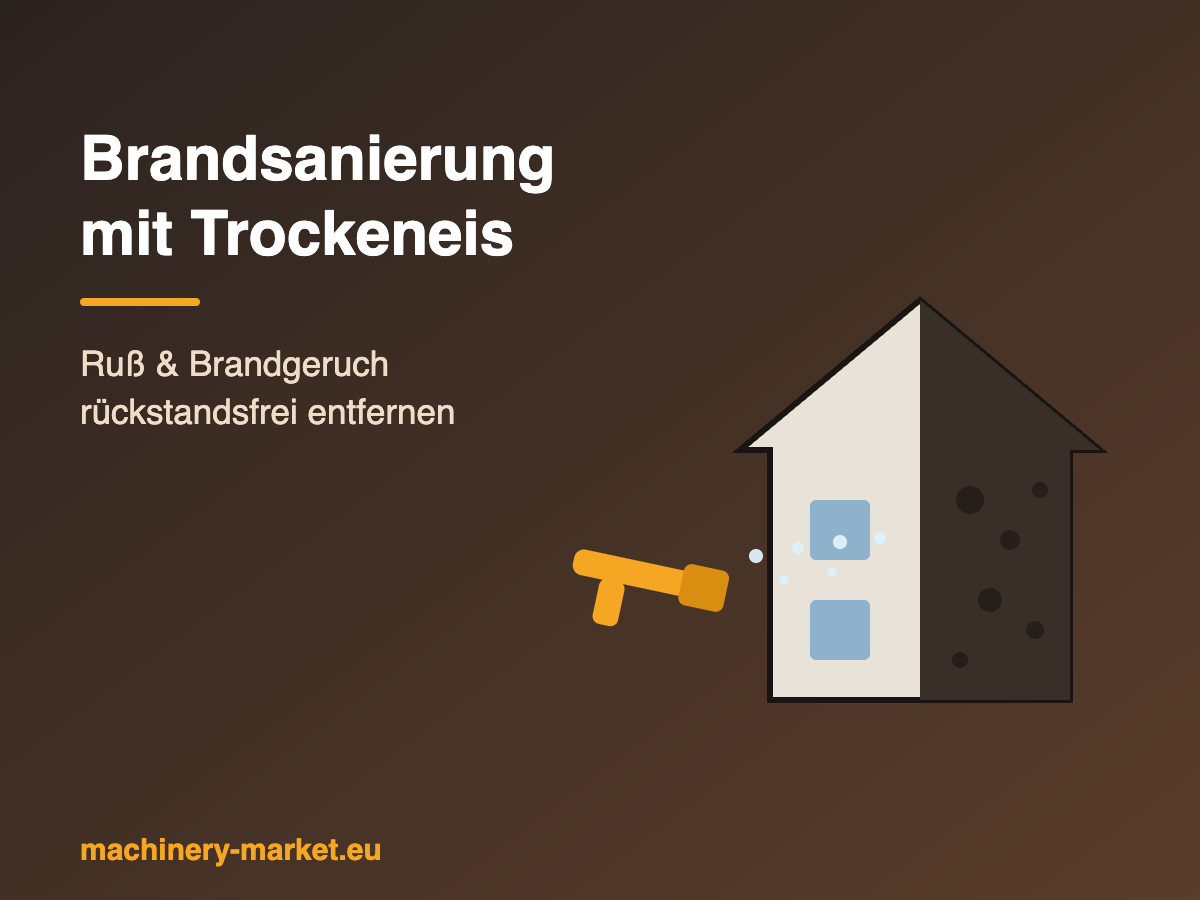
After a fire, every day counts. Soot eats into wood, masonry and metal, whilst the smell of smoke becomes ingrained in every pore – and until the building has been restored, the building or production hall remains out of action. Dry-ice cleaning has therefore established itself as the standard method for professional fire restoration: It removes soot and odour-causing substances without leaving any residue, without water, without chemicals and without damaging the building fabric. This practical guide shows restoration companies and building service providers how the process works, which equipment has proven effective – and what matters most in terms of safety and cost-effectiveness.
Why dry ice is the method of choice for fire damage
Soot is a tricky opponent: it is greasy, corrosive, harmful to health – and it carries the odours caused by the fire. Traditional removal methods quickly reach their limits: washing often merely spreads the soot and introduces moisture into the already damaged building; sandblasting removes the surface material along with the soot and produces mountains of contaminated blasting residue; and manual sanding takes an age.
Dry ice blasting solves all these problems at once:
- No water: no additional moisture penetration, no risk of mould in the already weakened building – which is crucial, particularly after fire-fighting operations.
- No additional waste: the pellets sublimate without leaving any residue. Only the removed soot itself needs to be disposed of – not tonnes of contaminated blasting grit.
- Gentle on materials: sound timber, half-timbered structures, natural stone, brick and metal remain undamaged. Only the damaged layer is removed – crucial for heritage conservation and structural integrity.
- Odour removal at the source: The smell of smoke is trapped in the soot layer. Once this is completely removed, the main source of the odour disappears – the basis of any successful odour remediation.
- Reaches every nook and cranny: The blasting process also cleans beam corners, partitions, profiles and installations that a sander cannot reach.
Typical areas of application in fire restoration
- Roof trusses and timber-beamed ceilings: removing soot and superficial charring from load-bearing beams – the surveyor can then assess the actual loss of cross-sectional area.
- Half-timbered structures and listed buildings: gentle cleaning of historic timber and partitions without loss of material.
- Masonry, concrete and plaster: soot streaks from walls and ceilings, even over large areas.
- Steel girders and metal structures: removal of soot and scale; corrosion protection can be reapplied immediately.
- Machinery and production plant: Following fires in industrial halls, plant, control cabinets and electronic equipment can be dry-cleaned – often saving them from total write-off.
- Charred layers with abrasive additive: With an optional blasting agent (e.g. on the Deckert DC280), even heavily charred timber can be stripped back to its sound core.
The process in practice: from damage assessment to a clean surface
- Site inspection and approval: Check structural integrity, ascertain the level of contamination (soot may contain PAHs and other pollutants), agree on a restoration plan with the surveyor/insurance company.
- Rough clearance: Remove fire debris and loose parts; cordon off affected areas.
- Dry ice blasting: systematically from top to bottom; adjust the ice flow rate and pressure according to the substrate – vigorous on steel, carefully controlled on historic timber.
- Extraction and disposal: The removed soot falls as dry residue and is extracted and disposed of in accordance with regulations.
- Fine-tuning and odour neutralisation: Only after the mechanical removal of soot do supplementary methods (e.g. ozone or fragrance neutralisation) work properly – because the source of the odour has been removed.
The right equipment: machine, compressed air, accessories
Fire restoration places special demands on the technology – and these are different from what many first-time buyers might think:
- The power is often cut off after a fire. This is precisely where a fully pneumatic two-hose unit such as the Deckert DC280 Vario Blaster really comes into its own: it requires no mains power – just compressed air from a mobile compressor. With the abrasive option, it can also treat charred layers.
- For large-scale soot removal on roof trusses and in halls, the powerful White Lion WL 3000 Profi (single-hose, 20–120 kg/h) is the right choice – where 230 V is available, its low power consumption of just 750 W is even sufficient for the site power distribution board.
- Mobile compressed air is essential: a diesel-powered site compressor such as the Atlas Copco XATS 138 makes the team completely self-sufficient. The ready-made complete packages – such as the WL 3000 Profi + XATS 138 or the DCE 480 + XATS 138 for large-scale projects – are tailored precisely to this application: hook up, drive there, carry out the renovation.
- Nozzles for every situation: flat jet for surfaces, circular jet for beam angles – the right nozzle sets are an essential part of any restoration kit.
You’ll find the complete range – new and second-hand – in the Dry Ice Blasting Machines category, and the suitable mobile compressed air units under Construction Compressors.
Safety: keeping CO₂, soot and noise under control
Professional fire damage restoration using dry ice requires rigorous health and safety measures:
- Ensure ventilation: Sublimating dry ice turns into CO₂ gas. In enclosed spaces, ventilation – either natural or mechanical – is essential – CO₂ is heavier than air and accumulates in low-lying areas, cellars and pits.
- Respiratory protection against soot: Stirred-up fire soot may contain polycyclic aromatic hydrocarbons (PAHs) – particulate filters (minimum P3) and closed protective clothing are standard.
- Hearing protection: Blasting equipment and compressors can reach noise levels that make hearing protection essential.
- Protection against the cold: Dry ice has a temperature of −78.5 °C – never handle pellets with bare hands; use insulated gloves.
Cost-effectiveness: Why the process pays off twice over for renovation contractors
For restoration companies, dry-ice blasting is attractive not only from a technical perspective but also from a business point of view:
- Speed: Compared with manual grinding or brushing, the area covered per unit of time is several times higher – an immediate selling point for time-sensitive insurance claims.
- Insurance business: Fire damage is generally settled by insurers – professional, documented processes with predictable costs are favoured when contracts are awarded.
- Preserving value rather than demolition: Where structures are cleaned rather than replaced, the total cost of the damage is reduced – this makes restoration contractors using dry ice technology the preferred partner for loss adjusters.
- Reuse of the equipment: Between fire-damage jobs, the same equipment generates income through industrial cleaning, façade cleaning, graffiti removal or vehicle detailing.
Buy or hire – the question for restoration contractors
For individual fire damage jobs, equipment can be hired – including a suitable compressor as a complete package. Those who incorporate fire restoration into their service portfolio on a permanent basis will find it significantly cheaper to buy (or lease/hire-purchase): the cost per job falls with every site. You can find a detailed decision-making guide, including an equipment overview and cost analysis, in our comprehensive guide ‘Buying or Renting Dry Ice Blasting Equipment’.
All equipment is supplied by GSK Baumaschinen – a verified dealer on machinery-market.eu, specialising in industrial-grade dry ice technology and construction compressors from a single source. Delivery across Europe; advice available in German and English.
Frequently asked questions about fire restoration using dry ice
Does dry ice blasting also remove the smell of smoke?
It removes the main source of the odour: the soot layer itself. Combined with subsequent odour neutralisation (e.g. ozone treatment), this is the most effective method – neutralisation without prior soot removal merely treats the symptoms.
Does the process work without a mains power supply?
Yes. Fully pneumatic dual-hose units such as the Deckert DC280 run entirely on compressed air; a diesel-powered site compressor (e.g. Atlas Copco XATS 138) makes the team self-sufficient – often the only practical solution after fires, when the electricity supply is cut off.
Is dry-ice blasting suitable for half-timbered buildings and heritage conservation?
Yes – it is actually the preferred method in such cases because it is non-abrasive and preserves the sound material. The ice flow rate and pressure are tailored to the historic material; the settings are verified in advance on test areas.
What happens to the removed soot?
The dry ice sublimates without leaving any residue; all that remains is the dry, removed soot. This is vacuumed up and disposed of professionally in accordance with the level of contamination – a fraction of the waste volume that would be produced by sandblasting.
Which machine is suitable for getting started in fire restoration?
The complete package comprising the White Lion WL 3000 Profi and a mobile AtlasCopco compressor has proven its worth – offering flexibility for both surfaces and construction sites. Those who frequently work on charred timber or need to work without electricity should supplement the fully pneumatic Deckert DC280 with the abrasive option. Second-hand equipment with low operating hours shortens the payback period.
Do you also deliver to other European countries?
Yes – all listings on machinery-market.eu are automatically available in 9 languages; delivery and intra-EU processing throughout the EU are standard practice.
Equipment for fire restoration: View all dry ice blasting machines and complete packages – new & used, for sale or hire. Questions about the right machine for your restoration project? Email us at info@machinery-market.eu – we’ll reply within 24–48 hours on working days.
No posts found
Write a reviewRecent posts
machinery-market.eu
The European marketplace for new and used machinery, commercial vehicles and industrial equipment.
Would you like to enquire about a machine?
Please contact the seller directly via the enquiry form in the listing or via the seller profile.
© 2025 - 2026 machinery-market.eu.
machinery-market.eu — the European online marketplace for used and new machinery. On our B2B platform, you’ll find thousands of verified listings from commercial sellers across Europe in the fields of construction equipment, agricultural machinery, food processing equipment, commercial vehicles, machine tools, and specialty equipment.
Our marketplace includes the following machinery and equipment categories, among others: Excavators, mini excavators, mobile excavators, crawler excavators, compact excavators, track excavators, wheel loaders, skid-steer loaders, farm loaders, telescopic loaders, dump trucks, articulated dump trucks, articulated trucks, rollers, tandem rollers, trench rollers, vibratory plates, rammers, compaction equipment, construction compressors, power generators, light towers, aerial work platforms, scissor lifts, telescopic work platforms, forklifts, forklifts, electric forklifts, container handlers, demolition excavators, demolition hammers, drilling rigs, earth rockets, pipe layers, plow layers, snow groomers, high-pressure cleaners, dry ice blasting machines, sandblasting systems, cleaning technology.
In the field of agricultural machinery and forestry equipment: tractors, combine harvesters, forage harvesters, balers, round balers, square balers, plows, cultivators, harrows, seeders, drillers, fertilizer spreaders, field sprayers, crop protection sprayers, trailers, dump trucks, silo trucks, slurry tankers, manure spreaders, front loaders, rear loaders, wood splitters, harvesters, forwarders, forestry mulchers, sawmill machinery, wood chippers, planers.
In the field of food and packaging technology: Packaging machines, labeling machines, filling systems, bottle fillers, conveyor belts, refrigeration systems, freezing systems, baking ovens, deck ovens, cutting machines, kneading machines, dough dividers, mixers, vacuum packaging machines, shrink tunnels, palletizers, robotic cells, CIP systems, pasteurizers.
In the field of machine tools, CNC, and metalworking: CNC lathes, CNC milling machines, machining centers, 5-axis machines, turning centers, grinding machines, cylindrical grinders, surface grinders, drilling machines, column drills, sawing machines, band saws, plasma cutters, laser cutting systems, waterjet systems, press brakes, shear machines, edge grinders, welding robots, robotic cells, 3D printers, generators.
In the commercial vehicles and transport sector: trucks, tractor-trailers, semi-trailers, trailers, low-loaders, dump trucks, refrigerated trucks, garbage trucks, vacuum excavators, vacuum trucks, flatbed trucks, box trucks, pickups, flatbed tarps, containers, swap bodies, roll-off dumpers, skip loaders, water trucks, spray trucks.
We facilitate business transactions in the following sectors: civil engineering, building construction, road construction, earthworks, demolition, recycling, landscaping, gardening and landscaping, agriculture and forestry, logistics, industry, metal construction, wood processing, food production, food processing, packaging industry, printing industry, pharmaceutical industry, construction companies, equipment rental, rental parks, workshop supplies, and blow-in technology.
Our listings reach buyers and sellers from Germany, including the following cities and regions: Berlin, Hamburg, Munich, Cologne, Frankfurt am Main, Stuttgart, Düsseldorf, Leipzig, Dortmund, Essen, Bremen, Dresden, Hanover, Nuremberg, Duisburg, Bochum, Wuppertal, Bielefeld, Bonn, Münster, Karlsruhe, Mannheim, Augsburg, Wiesbaden, Mönchengladbach, Gelsenkirchen, Aachen, Braunschweig, Chemnitz, Kiel, Halle (Saale), Magdeburg, Krefeld, Freiburg im Breisgau, Lübeck, Mainz, Erfurt, Oberhausen, Rostock, Kassel, Hagen, Saarbrücken, Hamm, Mülheim an der Ruhr, Ludwigshafen, Leverkusen, Oldenburg, Osnabrück, Solingen, Heidelberg, Herne, Neuss, Regensburg, Darmstadt, Paderborn, Würzburg, Ingolstadt, Heilbronn, Pforzheim, Göttingen, Bottrop, Reutlingen, Koblenz, Bremerhaven, Recklinghausen, Bergisch Gladbach, Jena, Trier, Erlangen, Moers, Siegen, Hildesheim, Salzgitter, Cottbus, Speyer, Hanhofen, Frankenthal, Kaiserslautern, Landau, Worms, Germersheim, Bad Dürkheim, Neustadt an der Weinstraße, Pirmasens, Zweibrücken, Bingen am Rhein.
Active throughout Europe—including in Austria (Vienna, Salzburg, Graz, Linz, Innsbruck, Klagenfurt), Switzerland (Zurich, Bern, Basel, Geneva, Lausanne, Lucerne, St. Gallen), the Netherlands (Amsterdam, Rotterdam, The Hague, Utrecht, Eindhoven, Tilburg, Groningen), Belgium (Brussels, Antwerp, Ghent, Liège, Bruges, Namur, Charleroi), Luxembourg (Luxembourg City, Esch-sur-Alzette), France (Paris, Marseille, Lyon, Toulouse, Nice, Nantes, Strasbourg, Bordeaux, Lille, Rennes, Le Havre), Italy (Rome, Milan, Naples, Turin, Palermo, Genoa, Bologna, Florence, Bari, Catania, Verona, Venice, Trieste, Padua, Brescia), Spain (Madrid, Barcelona, Valencia, Seville, Zaragoza, Málaga, Bilbao, Murcia, Granada, Alicante, Vigo), Portugal (Lisbon, Porto, Coimbra, Braga, Faro), Poland (Warsaw, Kraków, Łódź, Wrocław, Poznań, Gdańsk, Szczecin, Lublin, Katowice), the Czech Republic (Prague, Brno, Ostrava, Plzeň, Liberec), Slovakia (Bratislava, Košice, Žilina, Nitra), Hungary (Budapest, Debrecen, Szeged, Miskolc, Pécs, Győr), Slovenia (Ljubljana, Maribor, Celje), Croatia (Zagreb, Split, Rijeka, Osijek, Zadar), Romania (Bucharest, Cluj-Napoca, Iași, Timișoara, Constanța, Craiova, Brașov), Bulgaria (Sofia, Plovdiv, Varna, Burgas, Russe), Greece (Athens, Thessaloniki, Patras, Heraklion), Denmark (Copenhagen, Aarhus, Odense, Aalborg), Sweden (Stockholm, Gothenburg, Malmö, Uppsala, Västerås, Örebro), Norway (Oslo, Bergen, Stavanger, Trondheim, Drammen), Finland (Helsinki, Tampere, Turku, Oulu, Espoo), Estonia (Tallinn, Tartu, Narva), Latvia (Riga, Daugavpils, Liepāja), Lithuania (Vilnius, Kaunas, Klaipėda), Ireland (Dublin, Cork, Limerick, Galway), and the United Kingdom (London, Birmingham, Manchester, Glasgow, Liverpool, Leeds, Edinburgh, Cardiff, Belfast, Sheffield, Bristol).
* Unless otherwise stated, all prices are in euros plus the applicable statutory value-added tax. machinery-market.eu acts exclusively as an intermediary for businesses as defined in Section 14 of the German Civil Code (BGB), government agencies, and religious and social institutions. The purchase contract is concluded directly between the seller and the buyer—we act solely as an intermediary.