
- Construction machinery
- Agricultural machinery
- Food technology
- Transportfahrzeuge & Nutzfahrzeuge
- Metalworking machines & machine tools
- Woodworking machines
- Forklift trucks & industrial trucks
- Automation technology
- Conveyor & drive technology
- Storage technology
- Printing machines & printing presses
- Plastics processing & plastics technology
- Recycling & disposal machines
- Packaging machines
- Compressed air technology
- Measurement & testing technology
- Energy technology
- Chemical & pharmaceutical machines
- Municipal technology
- Cleaning technology
- Process engineering
- Refrigeration technology
- Medical technology
- Glass processing & ceramic processing
- Vacuum technology
- Surface technology
- Motors
- Surplus stock & remaining stock
- Wire processing machines
- Paper processing & film processing
- Textile machinery
- Filling systems & filling technology
- Special machines
- Other machines
- Power tools
- Automotive workshop equipment
- Stone working machines
- Office technology
- Purification technology
- Mail processing machines
- Telecommunications technology & computer technology
Choosing the right construction compressors: pressure, air flow and the right machine for every job
Two construction compressors may look almost identical on the outside – yet be designed for completely different tasks. One powers a demolition hammer on a building site, another blows fibre-optic cable through a conduit for kilometres, whilst a third supplies air to a drilling rig at a depth of 150 metres. If you choose the wrong size, you end up paying twice: too small means constant drops in pressure and sluggish performance; too large means unnecessary purchase, fuel and maintenance costs.
The good news is that the choice essentially comes down to two key parameters – pressure and air flow rate. A third factor is often overlooked, but in practice it is just as crucial to the outcome: air quality. Some tools require oiled air, whilst others must not come into contact with a single drop of oil. This guide explains all three parameters, matches typical construction site applications to their compressor classes, and highlights what matters when it comes to sizing.
The two key parameters that determine everything: pressure and air flow rate
Every construction compressor is described by two specifications, and together they determine what it is suitable for:
- Pressure (bar) = the force. It determines how much a tool can achieve – whether the chisel breaks the concrete, or whether the cable is pushed through the pipe. If the pressure is insufficient, simply not enough happens.
- Air flow rate (m³/min or l/min) = the stamina. It describes how much air is supplied per minute. A tool with high air consumption – such as a blast nozzle or several hammers operating simultaneously – requires a high air flow rate; otherwise, the pressure will drop during operation.
A simple mnemonic: pressure is the force, air flow is the breath. For conversion: 1 m³/min is equivalent to 1,000 l/min. A tool always requires both – a minimum pressure and a minimum air flow. The compressor must meet both requirements simultaneously; otherwise, you’ll be working at the limit.
Around 7 bar: the mobile all-rounder for the building site
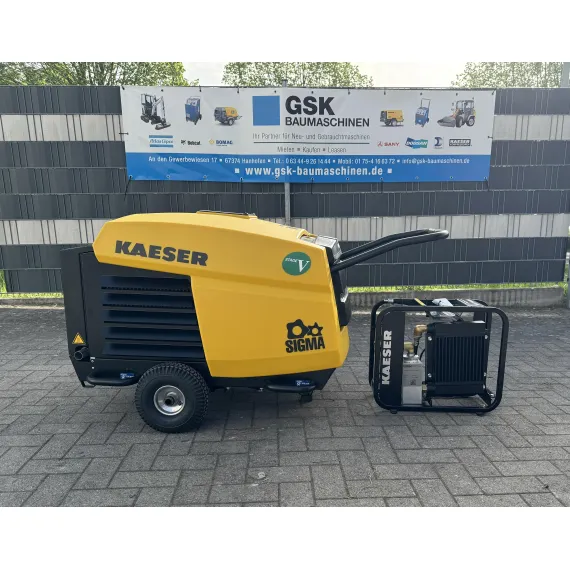 Example of the 7-bar class: Kaeser M17 MOBILAIR (new) – 7 bar, 1.6 m³/min · view listing
By far the most common class on construction sites operates at around 7 bar and approximately 1,000–3,000 l/min. This is the compact, often mobile construction compressor that powers day-to-day compressed air work:
- All kinds of pneumatic tools
- Demolition and chipping hammers, chipping work on concrete and masonry
- the ground-penetrating drill for trenchless ground penetration – to get through paths, driveways or flower beds without tearing them up
These machines are quick to set up, easy to transport and usually the most cost-effective solution for beginners. For the majority of standard civil engineering and demolition work, the 7-bar class is perfectly sized. You can find smaller construction compressors in this class – suitable for earth rockets, hammer drills and demolition hammers – here.
Important for percussive tools: hammer drills, demolition hammers and earth augers have moving parts inside that need to be lubricated. They therefore run on oiled (oil-containing) compressed air – an oil mist in the line keeps the striking piston and mechanics running smoothly. To achieve this, a mist lubricator (line lubricator) is fitted in the supply line to the tool. However, this very same air would be disastrous for blasting and coating work – more on this below.
Around 14 bar: domestic connection, cable and fibre-optic installation
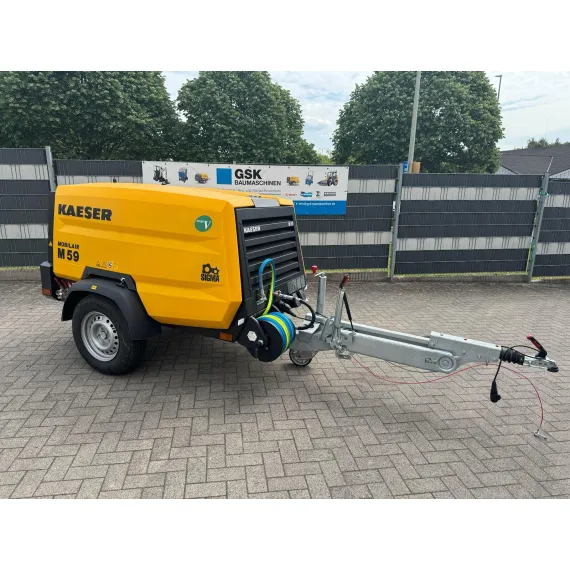 Example of the 14 bar class: Kaeser M59 PE (new) – 14 bar, 4.7 m³/min · view advert
Where the 7-bar compressor reaches its limits, the 14-bar class begins. The higher pressure provides the power needed to blow-in cables and empty conduits and to install house connections cleanly. This is particularly common in fibre-optic and broadband roll-out: the fibre is carried through the conduit by compressed air, and the correct pressure determines both the speed and the result. For short to medium-length blow-in distances, this class is the right choice.
High air volumes: sandblasting relies on flow rate
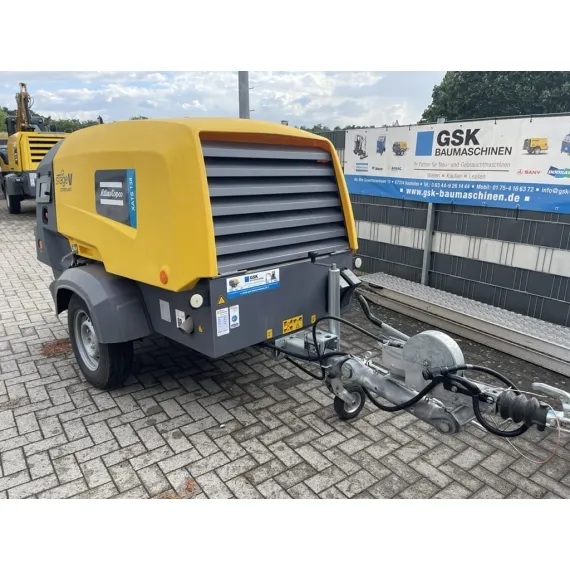 Example of blasting class: Atlas Copco XATS 138 (new) – 7 m³/min · view listing
When it comes to sandblasting, it is not so much the pressure that counts, but the air flow. From around 5,000 l/min at 7–10 bar, you can work quickly and without constant drops in pressure. If the compressor is too small, the consequences are noticeable: interruptions, an uneven blast pattern, longer working times and higher abrasive consumption. The right air flow ultimately saves you money. You can find compressors for sandblasting and dry ice blasting here.
High performance: dry ice blasting and long blast distances
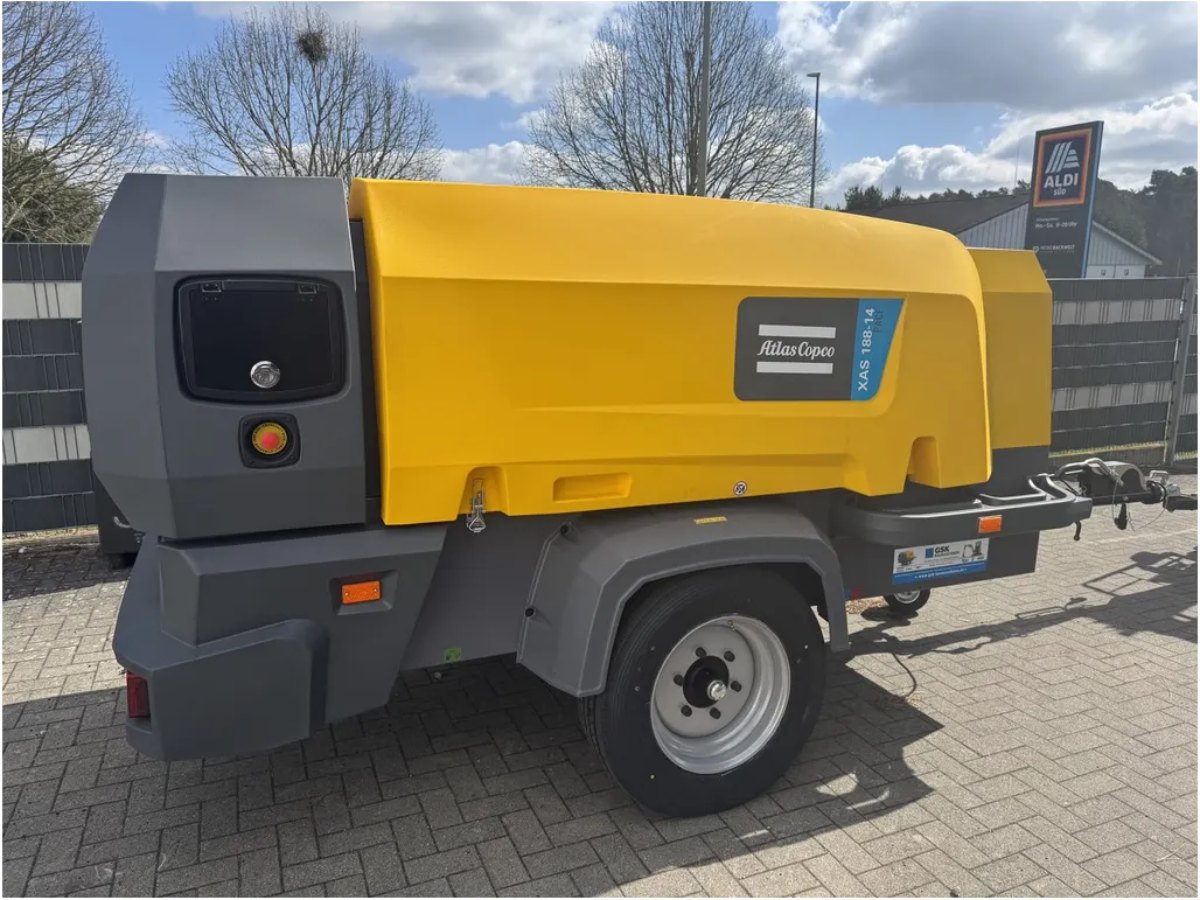
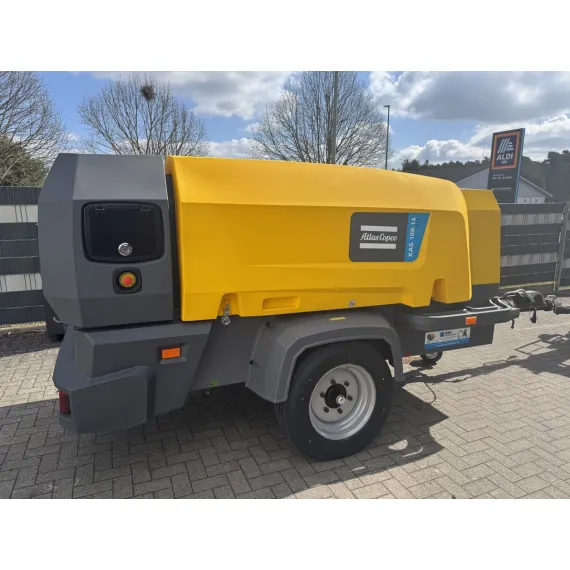 High-performance example: Atlas Copco XAS 188-14 (new) – 14 bar · view listing
Some applications require both high pressure and large air volumes – typically 10–14 bar and 7,000–11,000 l/min:
- Dry ice blasting: gentle, residue-free cleaning without water or blasting waste – from fire damage restoration and machine cleaning to the preservation of historic monuments. The price to pay for this level of cleanliness is a high air demand; an undersized machine immediately loses cleaning performance.
- Long blowing distances: Blowing fibreglass through pipes for 5 kilometres or more in a single stretch is only possible with a high air flow rate, which carries the cable evenly and without stoppages through the pipe. It is precisely these machines that determine the range per blowing operation.
View high-performance compressors for dry ice blasting and high air volumes.
Shotcrete: a constant air supply for material flow
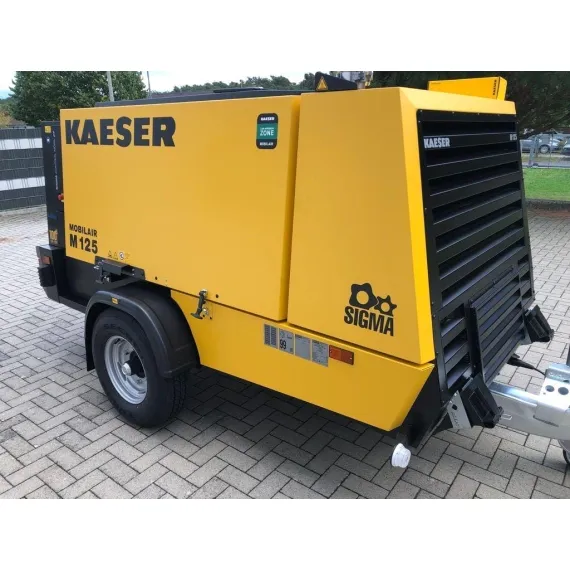 Example: Shotcrete: Kaeser M125 with air treatment (new) – 14 bar, 11.5 m³/min · view listing
Whether for slope stabilisation, tunnel construction or refurbishment: shotcrete systems convey and compact the concrete using compressed air. Without a steady flow rate in the range of approximately 7–11 m³/min, the flow of material breaks down – resulting in an uneven finish. Choosing the right compressor size is not a minor detail here, but a prerequisite for clean, professional work. View compressors for shotcrete and high-performance applications.
Up to 35 bar: the high-pressure league for drilling
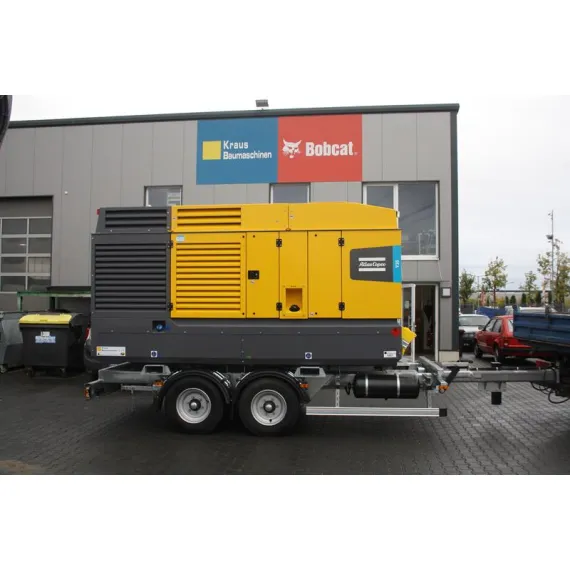 High-pressure example: Atlas Copco Y35 (new) – 35 bar, 34.8 m³/min · view listing
At the very top of the range is the high-pressure class, delivering up to 35 bar and around 35 m³/min. It is designed for drilling work – geothermal energy, well construction and deep earth drilling. These machines power the rotary hammer and reliably blow cuttings out of the borehole. This is a world apart from the construction site all-rounder: more power, more weight, a higher purchase price – but there’s simply no alternative for this task. You can find high-pressure compressors for well and geothermal drilling here.
The third dimension: air quality – oiled or bone-dry?
Pressure and volume alone say nothing about how clean the air needs to be. And this is precisely where the professional differs from the occasional user, as the requirements are diametrically opposed:
- Percussion and drilling tools require oiled air. Hammer drills, demolition hammers and earth rockets are lubricated by the oil mist in the compressed air (oil mist lubricators in the supply line). Without this lubrication, the mechanics run dry and wear out quickly.
- Blasting and coating require the exact opposite: oil-free, dry, cooled air. During sandblasting and particularly during dry-ice blasting, no oil or water droplets must come into contact with the surface – otherwise the blast finish suffers, and any subsequent coating will not adhere.
To turn the warm, humid compressed air into clean blasting air, a small treatment sequence is fitted downstream of the compressor:
- Aftercooler (NK): cools the compressed, hot air so that the water it contains can condense.
- Cyclone separator (ZK): uses centrifugal force to remove the condensed water and coarse droplets from the air.
- PD fine filter: removes the fine oil aerosols and residual droplets that slip past the aftercooler and cyclone.
This PD fine filter is essential for dry ice blasting: this process involves residue-free cleaning – often prior to recoating – and even the smallest traces of oil from the compressed air would contaminate precisely this clean surface.
In a professional context, this is not just a ‘nice to have’: the ZTV-SIB regulations (Protection and Repair of Concrete Structures) require oil- and grease-free surfaces for substrate preparation. Anyone repairing and blasting concrete cannot do without oil-free, dry compressed air. The same basic rule applies to shotcrete – a high, constant flow rate and oil-free air to ensure the concrete bond is not compromised; the exact quality requirements depend on the tender specifications and regulations.
For the advertisement, this means: a machine is only complete if the air treatment system is suited to the task. If a second-hand compressor is fitted with (or can be retrofitted with) an aftercooler, cyclone separator or fine filter, this must be included in the description – for blasting and repair companies, this is the decisive selling point.
How big does my compressor need to be?
Sizing is always based on the tool, not the compressor. Three rules of thumb will help with the selection:
- Tool requirements first. Every compressed-air tool specifies a minimum pressure and an air consumption (l/min or m³/min). Both values represent the lower limit – the compressor must be able to deliver them continuously, not just for short periods.
- Allow for a margin. A surcharge of around 20–30 per cent on the calculated air demand accounts for pipe losses, wear and tear, and tools used simultaneously. If you are operating several tools at the same time, add up their air demands.
- If in doubt, err on the side of the higher volume. Most practical problems arise not from insufficient pressure, but from insufficient air flow. A compressor that ‘breaks down’ during continuous operation has almost always been selected with an air flow that is too low.
It’s worth taking an honest look at actual usage: if you only carry out heavy-duty work occasionally, you don’t need a blast machine; if you blow in glass fibre daily, you shouldn’t skimp on the pressure rating.
Overview: Pressure, air flow and application at a glance
| Class | Pressure | Airflow | Typical applications | Air quality |
|---|---|---|---|---|
| Small / portable | ~7 bar | ~1,000–3,000 l/min | Pneumatic tools, demolition/chipping hammers, earth rocket | Oiled (mist lubrication) |
| Medium, high pressure | ~14 bar | medium range | House connection, blowing in cables/fibre optics (shorter distances) | depending on the tool |
| Large / Blasting | 7–10 bar | from ~5,000 l/min | Sandblasting, surface blasting | oil-free, dry (NK + ZK + PD) |
| Large / High-performance | 10–14 bar | ~7,000–11,000 l/min | Dry ice blasting, long blast distances, shotcrete | Oil-free, dry; dry ice: PD fine filter required |
| Drilling / High-pressure | up to ~35 bar | up to ~35 m³/min | Geothermal energy, well and ground drilling | oiled (rotary hammer) |
These figures are practical guidelines – the exact specifications will always depend on the specific tool and application.
Frequently asked questions
What is the difference between bar and m³/min for a compressor?
Bar indicates the pressure – the force with which the air operates. m³/min (or l/min) indicates the flow rate – the volume of air delivered per minute. Both values must be suitable for the task at hand: the pressure determines whether a tool will operate at all, whilst the flow rate determines whether it can do so continuously without a drop in pressure.
How many bar do you need for sandblasting?
For sandblasting, you usually work with 7–10 bar. However, the air flow rate is the most important factor: from around 5,000 l/min, you can sandblast quickly and evenly. A compressor that is too small leads to pressure drops, uneven results and higher abrasive consumption.
Which compressor is suitable for cable and fibre-optic blowing?
For property connections and shorter distances, the 14 bar class is the right choice. Long insertion distances of 5 kilometres or more also require a high air flow rate (around 7,000–11,000 l/min at 10–14 bar) to ensure the cable is carried evenly through the pipe without any stoppages.
How powerful does my construction compressor need to be?
The choice depends on the tool: every pneumatic tool specifies a minimum pressure and an air requirement. You should allow for a reserve of around 20–30 per cent on top of the air requirement to account for losses and simultaneous use. Most sizing errors relate to the air volume, not the pressure.
Which compressor is used for drilling?
Drilling work such as geothermal drilling, well drilling and earth drilling requires high-pressure compressors with pressures of up to around 35 bar and air flow rates of up to approximately 35 m³/min. These power the rotary hammer and blow the cuttings out of the borehole.
Do I need oiled or oil-free compressed air?
That depends on the tool. Impact and drilling tools (hammer drill, demolition hammer, earth rocket) require oiled air for lubrication – supplied via a mist lubricator in the supply line. Blasting and coating work, on the other hand, requires oil-free, dry air, treated via aftercoolers, cyclone separators and fine filters. For dry ice blasting, a PD fine filter is mandatory, and concrete repair in accordance with ZTV-SIB requires oil- and grease-free surfaces.
Looking for the right construction compressor? Whether it’s a 7-bar all-rounder, a 14-bar machine for fibre-optic installation or a high-pressure compressor for drilling – at machinery-market.eu you’ll find used and new compressors from verified dealers across Europe. View the latest compressors or browse the entire range of construction machinery.
No posts found
Write a reviewRecent posts
- Reach stacker or container forklift? Which machine is best suited to which type of container handling?
- Buying heavy-duty forklift trucks: load capacity, centre of gravity and checking the condition of second-hand machinery
- Choosing the right construction compressors: pressure, air flow and the right machine for every job
machinery-market.eu
The European marketplace for new and used machinery, commercial vehicles and industrial equipment.
Would you like to enquire about a machine?
Please contact the seller directly via the enquiry form in the listing or via the seller profile.
© 2025 - 2026 machinery-market.eu.
machinery-market.eu — the European online marketplace for used and new machinery. On our B2B platform, you’ll find thousands of verified listings from commercial sellers across Europe in the fields of construction equipment, agricultural machinery, food processing equipment, commercial vehicles, machine tools, and specialty equipment.
Our marketplace includes the following machinery and equipment categories, among others: Excavators, mini excavators, mobile excavators, crawler excavators, compact excavators, track excavators, wheel loaders, skid-steer loaders, farm loaders, telescopic loaders, dump trucks, articulated dump trucks, articulated trucks, rollers, tandem rollers, trench rollers, vibratory plates, rammers, compaction equipment, construction compressors, power generators, light towers, aerial work platforms, scissor lifts, telescopic work platforms, forklifts, forklifts, electric forklifts, container handlers, demolition excavators, demolition hammers, drilling rigs, earth rockets, pipe layers, plow layers, snow groomers, high-pressure cleaners, dry ice blasting machines, sandblasting systems, cleaning technology.
In the field of agricultural machinery and forestry equipment: tractors, combine harvesters, forage harvesters, balers, round balers, square balers, plows, cultivators, harrows, seeders, drillers, fertilizer spreaders, field sprayers, crop protection sprayers, trailers, dump trucks, silo trucks, slurry tankers, manure spreaders, front loaders, rear loaders, wood splitters, harvesters, forwarders, forestry mulchers, sawmill machinery, wood chippers, planers.
In the field of food and packaging technology: Packaging machines, labeling machines, filling systems, bottle fillers, conveyor belts, refrigeration systems, freezing systems, baking ovens, deck ovens, cutting machines, kneading machines, dough dividers, mixers, vacuum packaging machines, shrink tunnels, palletizers, robotic cells, CIP systems, pasteurizers.
In the field of machine tools, CNC, and metalworking: CNC lathes, CNC milling machines, machining centers, 5-axis machines, turning centers, grinding machines, cylindrical grinders, surface grinders, drilling machines, column drills, sawing machines, band saws, plasma cutters, laser cutting systems, waterjet systems, press brakes, shear machines, edge grinders, welding robots, robotic cells, 3D printers, generators.
In the commercial vehicles and transport sector: trucks, tractor-trailers, semi-trailers, trailers, low-loaders, dump trucks, refrigerated trucks, garbage trucks, vacuum excavators, vacuum trucks, flatbed trucks, box trucks, pickups, flatbed tarps, containers, swap bodies, roll-off dumpers, skip loaders, water trucks, spray trucks.
We facilitate business transactions in the following sectors: civil engineering, building construction, road construction, earthworks, demolition, recycling, landscaping, gardening and landscaping, agriculture and forestry, logistics, industry, metal construction, wood processing, food production, food processing, packaging industry, printing industry, pharmaceutical industry, construction companies, equipment rental, rental parks, workshop supplies, and blow-in technology.
Our listings reach buyers and sellers from Germany, including the following cities and regions: Berlin, Hamburg, Munich, Cologne, Frankfurt am Main, Stuttgart, Düsseldorf, Leipzig, Dortmund, Essen, Bremen, Dresden, Hanover, Nuremberg, Duisburg, Bochum, Wuppertal, Bielefeld, Bonn, Münster, Karlsruhe, Mannheim, Augsburg, Wiesbaden, Mönchengladbach, Gelsenkirchen, Aachen, Braunschweig, Chemnitz, Kiel, Halle (Saale), Magdeburg, Krefeld, Freiburg im Breisgau, Lübeck, Mainz, Erfurt, Oberhausen, Rostock, Kassel, Hagen, Saarbrücken, Hamm, Mülheim an der Ruhr, Ludwigshafen, Leverkusen, Oldenburg, Osnabrück, Solingen, Heidelberg, Herne, Neuss, Regensburg, Darmstadt, Paderborn, Würzburg, Ingolstadt, Heilbronn, Pforzheim, Göttingen, Bottrop, Reutlingen, Koblenz, Bremerhaven, Recklinghausen, Bergisch Gladbach, Jena, Trier, Erlangen, Moers, Siegen, Hildesheim, Salzgitter, Cottbus, Speyer, Hanhofen, Frankenthal, Kaiserslautern, Landau, Worms, Germersheim, Bad Dürkheim, Neustadt an der Weinstraße, Pirmasens, Zweibrücken, Bingen am Rhein.
Active throughout Europe—including in Austria (Vienna, Salzburg, Graz, Linz, Innsbruck, Klagenfurt), Switzerland (Zurich, Bern, Basel, Geneva, Lausanne, Lucerne, St. Gallen), the Netherlands (Amsterdam, Rotterdam, The Hague, Utrecht, Eindhoven, Tilburg, Groningen), Belgium (Brussels, Antwerp, Ghent, Liège, Bruges, Namur, Charleroi), Luxembourg (Luxembourg City, Esch-sur-Alzette), France (Paris, Marseille, Lyon, Toulouse, Nice, Nantes, Strasbourg, Bordeaux, Lille, Rennes, Le Havre), Italy (Rome, Milan, Naples, Turin, Palermo, Genoa, Bologna, Florence, Bari, Catania, Verona, Venice, Trieste, Padua, Brescia), Spain (Madrid, Barcelona, Valencia, Seville, Zaragoza, Málaga, Bilbao, Murcia, Granada, Alicante, Vigo), Portugal (Lisbon, Porto, Coimbra, Braga, Faro), Poland (Warsaw, Kraków, Łódź, Wrocław, Poznań, Gdańsk, Szczecin, Lublin, Katowice), the Czech Republic (Prague, Brno, Ostrava, Plzeň, Liberec), Slovakia (Bratislava, Košice, Žilina, Nitra), Hungary (Budapest, Debrecen, Szeged, Miskolc, Pécs, Győr), Slovenia (Ljubljana, Maribor, Celje), Croatia (Zagreb, Split, Rijeka, Osijek, Zadar), Romania (Bucharest, Cluj-Napoca, Iași, Timișoara, Constanța, Craiova, Brașov), Bulgaria (Sofia, Plovdiv, Varna, Burgas, Russe), Greece (Athens, Thessaloniki, Patras, Heraklion), Denmark (Copenhagen, Aarhus, Odense, Aalborg), Sweden (Stockholm, Gothenburg, Malmö, Uppsala, Västerås, Örebro), Norway (Oslo, Bergen, Stavanger, Trondheim, Drammen), Finland (Helsinki, Tampere, Turku, Oulu, Espoo), Estonia (Tallinn, Tartu, Narva), Latvia (Riga, Daugavpils, Liepāja), Lithuania (Vilnius, Kaunas, Klaipėda), Ireland (Dublin, Cork, Limerick, Galway), and the United Kingdom (London, Birmingham, Manchester, Glasgow, Liverpool, Leeds, Edinburgh, Cardiff, Belfast, Sheffield, Bristol).
* Unless otherwise stated, all prices are in euros plus the applicable statutory value-added tax. machinery-market.eu acts exclusively as an intermediary for businesses as defined in Section 14 of the German Civil Code (BGB), government agencies, and religious and social institutions. The purchase contract is concluded directly between the seller and the buyer—we act solely as an intermediary.