
- Construction machinery
- Agricultural machinery
- Food technology
- Transportfahrzeuge & Nutzfahrzeuge
- Metalworking machines & machine tools
- Woodworking machines
- Forklift trucks & industrial trucks
- Automation technology
- Conveyor & drive technology
- Storage technology
- Printing machines & printing presses
- Plastics processing & plastics technology
- Recycling & disposal machines
- Packaging machines
- Compressed air technology
- Measurement & testing technology
- Energy technology
- Chemical & pharmaceutical machines
- Municipal technology
- Cleaning technology
- Process engineering
- Refrigeration technology
- Medical technology
- Glass processing & ceramic processing
- Vacuum technology
- Surface technology
- Motors
- Surplus stock & remaining stock
- Wire processing machines
- Paper processing & film processing
- Textile machinery
- Filling systems & filling technology
- Special machines
- Other machines
- Power tools
- Automotive workshop equipment
- Stone working machines
- Office technology
- Purification technology
- Mail processing machines
- Telecommunications technology & computer technology
Reach stacker or container forklift? Which machine is best suited to which type of container handling?
Anyone who moves containers on their own premises – at a rail terminal, an inland port, a container yard or within a factory’s logistics operations – will sooner or later face the same question: reachstacker or container forklift? Both lift 20- and 40-foot containers, and at first glance both look like ‘large forklift trucks’. In practice, however, they are two different pieces of equipment for two different tasks. Anyone who buys the wrong one either pays for reach they’ll never need – or wastes time and space every day.
The reach stacker: reach beyond the first row
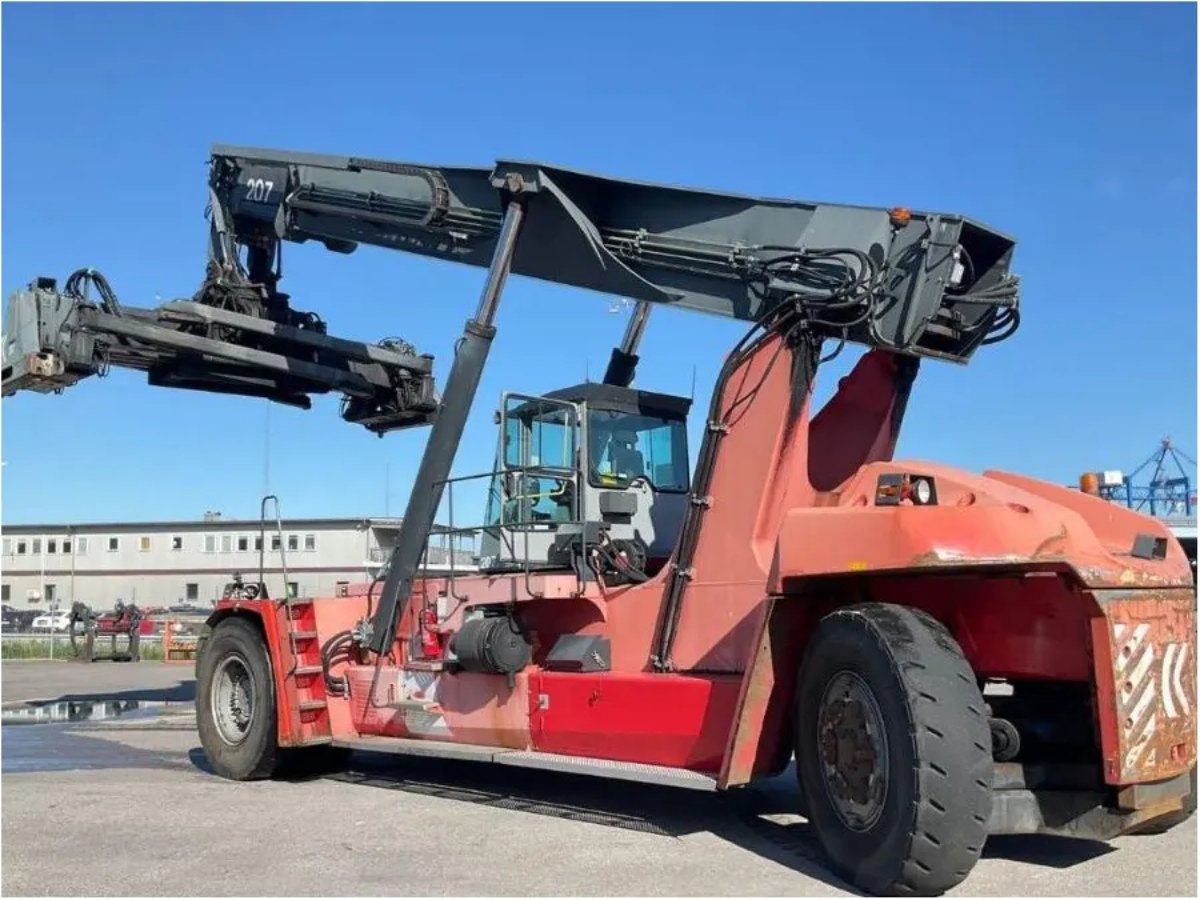
 Reachstacker: Kalmar DRF450-75C5XS, 45 t in the first row, telescopic boom with spreader · view advert
The defining feature of this reachstacker is its telescopic boom with spreader. The spreader grips the container from above at the four corner fittings and locks automatically in place with twist locks. Because the boom is telescopic, the machine can reach across one row of containers into the second – and, in certain models, even into the third – row.
This is precisely what determines the lifting capacity specification, which you need to understand when making a purchase: a 45-tonne reachstacker lifts 45 t only in the first row. In the second row, depending on the model, the capacity is around 27–31 t, and significantly less in the third row. Example: Kalmar DRF450: 45 t in the first row, 27 t in the second row, stacking height of five containers high, operating weight around 67 t, engine power 256 kW, fuel consumption in normal driving conditions approximately 20 l/h. For 90-degree stacking, it requires an aisle of at least 11.2 m (20 feet) or 13.6 m (40 feet).
Who it’s for: Anyone who needs to stack containers in multiple rows – in other words, those looking to save space – such as terminals, depots and ports with limited space. And for anyone who lifts containers from rail wagons or chassis where it is not possible to approach from the front.
The container forklift: fast, simple, more affordable – all in one range
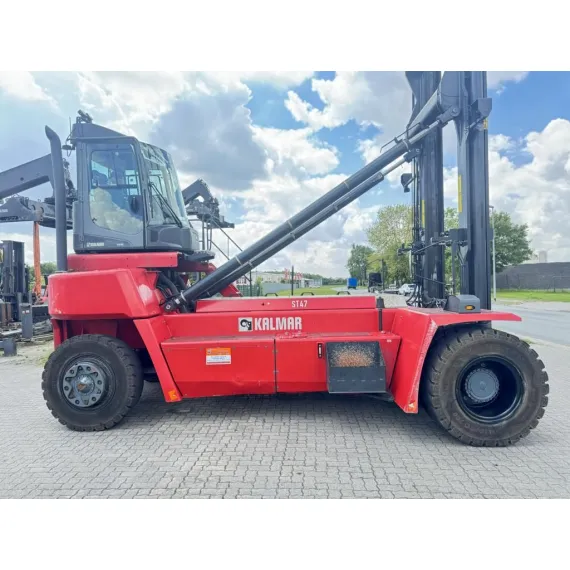 Empty container forklift: Kalmar DCG100-45ED7, 10 t load capacity, 18.8 m lift height · view listing
At its core, the container handler is a counterbalanced forklift with a lifting mast. Instead of forks, it is fitted with a top-lift spreader (which grips from above) or – in the case of empty container handlers – often a side gripper. It lifts vertically in front of it, meaning it can only handle the top row at any one time. As a result, it is mechanically simpler, lighter, more manoeuvrable and cheaper to purchase and maintain than a reach stacker of the same class.
There are two distinct types:
- Empty container handlers: typically with a lifting capacity of 8–10 t, stacking empty containers seven to eight high. Example from our fleet: Kalmar DCG100-45ED7 with a lifting capacity of 10 t and a lift height of 18.8 m – built for the depot, where the focus is on volume per hour, not weight.
- Full container handler: Lifting capacity 30–45 t, stacks loaded containers three to five high in a single row. The alternative to the reachstacker wherever single-row stacking is required and space is not an issue.
View used container handlers on machinery-market.eu.
The decision in three questions
- How do you stack? Single-row with an aisle between each row → container stacker. Multi-row, block by block → reach stacker. Rule of thumb: the reach stacker requires less space per stored container, whilst the container stacker costs less.
- Empty or loaded? Mainly empty containers in the depot → empty container forklift – by far the most cost-effective machine for this job. Loaded containers → full container forklift or reach stacker.
- What are you lifting from? From railway wagons or over obstacles → Reachstacker. From the ground or directly from the chassis with unobstructed access → A container forklift is sufficient.
What to look out for when buying second-hand
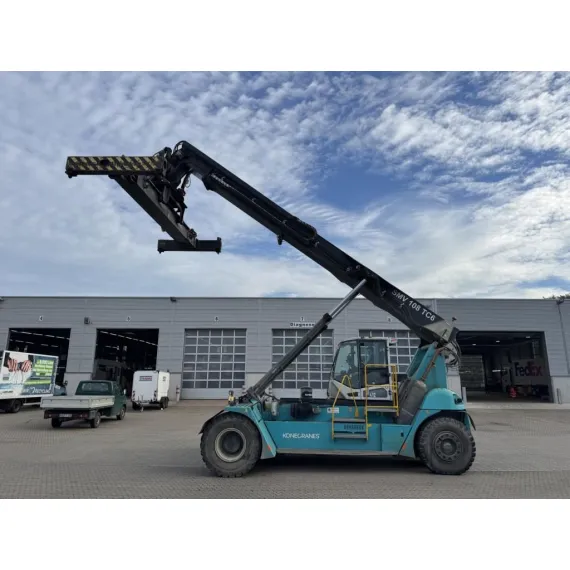 Check the following when buying second-hand: boom, telescopic guides and spreader – here is an SMV 108TC6 · view listing
For both types of machine, the condition of the load-handling equipment determines the ongoing costs. For reach stackers, these are the boom, telescopic guides and spreaders (twist locks, locking sensors, side shift); for container handlers, they are the lift mast, chains and spreaders. In addition, for both: operating hours in relation to the year of manufacture (more than 1,000 hours per year is considered intensive use), the condition of the tyres – large tyres are a real cost factor – the transmission and axles, the tightness of the hydraulics after 15 minutes of operation of all functions, and the latest test report in accordance with FEM 4.004 (the annual expert inspection, formerly known as the ‘UVV inspection’).
A note on logistics: a 45-tonne reach stacker weighs around 67 tonnes and is over four metres wide. Transport, installation space and ground-bearing capacity must be clarified before purchase – not afterwards.
And the terminal tractor?
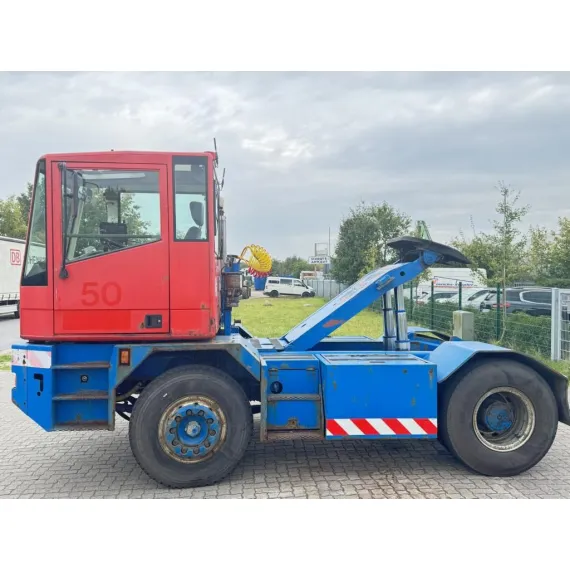 Terminal tractor: CVS Ferrari TT2516BV 4x2 for manoeuvring trailers on site · view listing
Where containers are not stacked but moved on trailers – between the ramp, the warehouse and the storage area – the third machine in the fleet is required: the terminal tractor (a tractor unit with a hydraulically lifting fifth wheel). It does not replace either of the other two, but complements them wherever manoeuvring sets the pace. View terminal tractors in stock.
At a glance
| Machine | Load capacity | Reach | Stacking height | Typical application |
|---|---|---|---|---|
| Reach stacker | up to 45 t (1st row), ~27–31 t (2nd row) | 2nd–3rd row | Up to 5 high | Terminal, port, railway – multi-row, limited space |
| Full-container forklift | 30–45 t | 1st row | 3–5 high | Single-row stacking of loaded containers |
| Empty container forklift | 8–10 t | 1st row | 7–8 high | Depot, empty containers, high throughput |
| Terminal tractor | Semi-trailer load up to ~25–35 t | – | – | Trailers manoeuvring on site |
Figures are for guidance only; the load capacity chart for the specific machine always takes precedence.
Frequently asked questions
What is the difference between a reach stacker and a container forklift?
A reach stacker lifts using a telescopic boom and spreader and can reach across the first row of containers into the second and third rows. A container forklift lifts vertically in front of it using a mast and only serves the first row – but is simpler, lighter and cheaper.
How much can a 45-metric-tonne reachstacker lift in the second row?
Significantly less than in the first row: the Kalmar DRF450 has a capacity of 45 t in the first row and 27 t in the second row. The lifting capacity decreases with reach – the load chart for the specific model is the decisive factor.
When is an empty container handler sufficient?
When mainly empty containers are being moved and stacked high, for example in a container depot. Empty container stackers with a lifting capacity of 8–10 t can stack seven to eight containers high and are the most cost-effective solution for this job.
How much space does a reach stacker need?
For 90-degree stacking, a 45-t reach stacker requires an aisle of at least approximately 11.2 m for 20-foot containers and 13.6 m for 40-foot containers. In return, it can stack in multiple rows, saving space overall.
What should I look out for when buying a second-hand reach stacker?
Check the boom, telescopic guides and spreader – including twist locks and sensors – as well as operating hours in relation to the year of manufacture, tyre condition, hydraulic integrity and a current inspection report in accordance with FEM 4.004.
Looking for a reach stacker, container handler or terminal tractor? On machinery-market.eu, you’ll find used container handling equipment from verified dealers – complete with technical specifications, operating hours and photos for every machine. View reach stackers · Container forklifts · Heavy-duty forklifts · All machines from Hinrichs Flurfördergeräte (Oldenburg).
No posts found
Write a reviewRecent posts
- Reach stacker or container forklift? Which machine is best suited to which type of container handling?
- Buying heavy-duty forklift trucks: load capacity, centre of gravity and checking the condition of second-hand machinery
- Choosing the right construction compressors: pressure, air flow and the right machine for every job
machinery-market.eu
The European marketplace for new and used machinery, commercial vehicles and industrial equipment.
Would you like to enquire about a machine?
Please contact the seller directly via the enquiry form in the listing or via the seller profile.
© 2025 - 2026 machinery-market.eu.
machinery-market.eu — the European online marketplace for used and new machinery. On our B2B platform, you’ll find thousands of verified listings from commercial sellers across Europe in the fields of construction equipment, agricultural machinery, food processing equipment, commercial vehicles, machine tools, and specialty equipment.
Our marketplace includes the following machinery and equipment categories, among others: Excavators, mini excavators, mobile excavators, crawler excavators, compact excavators, track excavators, wheel loaders, skid-steer loaders, farm loaders, telescopic loaders, dump trucks, articulated dump trucks, articulated trucks, rollers, tandem rollers, trench rollers, vibratory plates, rammers, compaction equipment, construction compressors, power generators, light towers, aerial work platforms, scissor lifts, telescopic work platforms, forklifts, forklifts, electric forklifts, container handlers, demolition excavators, demolition hammers, drilling rigs, earth rockets, pipe layers, plow layers, snow groomers, high-pressure cleaners, dry ice blasting machines, sandblasting systems, cleaning technology.
In the field of agricultural machinery and forestry equipment: tractors, combine harvesters, forage harvesters, balers, round balers, square balers, plows, cultivators, harrows, seeders, drillers, fertilizer spreaders, field sprayers, crop protection sprayers, trailers, dump trucks, silo trucks, slurry tankers, manure spreaders, front loaders, rear loaders, wood splitters, harvesters, forwarders, forestry mulchers, sawmill machinery, wood chippers, planers.
In the field of food and packaging technology: Packaging machines, labeling machines, filling systems, bottle fillers, conveyor belts, refrigeration systems, freezing systems, baking ovens, deck ovens, cutting machines, kneading machines, dough dividers, mixers, vacuum packaging machines, shrink tunnels, palletizers, robotic cells, CIP systems, pasteurizers.
In the field of machine tools, CNC, and metalworking: CNC lathes, CNC milling machines, machining centers, 5-axis machines, turning centers, grinding machines, cylindrical grinders, surface grinders, drilling machines, column drills, sawing machines, band saws, plasma cutters, laser cutting systems, waterjet systems, press brakes, shear machines, edge grinders, welding robots, robotic cells, 3D printers, generators.
In the commercial vehicles and transport sector: trucks, tractor-trailers, semi-trailers, trailers, low-loaders, dump trucks, refrigerated trucks, garbage trucks, vacuum excavators, vacuum trucks, flatbed trucks, box trucks, pickups, flatbed tarps, containers, swap bodies, roll-off dumpers, skip loaders, water trucks, spray trucks.
We facilitate business transactions in the following sectors: civil engineering, building construction, road construction, earthworks, demolition, recycling, landscaping, gardening and landscaping, agriculture and forestry, logistics, industry, metal construction, wood processing, food production, food processing, packaging industry, printing industry, pharmaceutical industry, construction companies, equipment rental, rental parks, workshop supplies, and blow-in technology.
Our listings reach buyers and sellers from Germany, including the following cities and regions: Berlin, Hamburg, Munich, Cologne, Frankfurt am Main, Stuttgart, Düsseldorf, Leipzig, Dortmund, Essen, Bremen, Dresden, Hanover, Nuremberg, Duisburg, Bochum, Wuppertal, Bielefeld, Bonn, Münster, Karlsruhe, Mannheim, Augsburg, Wiesbaden, Mönchengladbach, Gelsenkirchen, Aachen, Braunschweig, Chemnitz, Kiel, Halle (Saale), Magdeburg, Krefeld, Freiburg im Breisgau, Lübeck, Mainz, Erfurt, Oberhausen, Rostock, Kassel, Hagen, Saarbrücken, Hamm, Mülheim an der Ruhr, Ludwigshafen, Leverkusen, Oldenburg, Osnabrück, Solingen, Heidelberg, Herne, Neuss, Regensburg, Darmstadt, Paderborn, Würzburg, Ingolstadt, Heilbronn, Pforzheim, Göttingen, Bottrop, Reutlingen, Koblenz, Bremerhaven, Recklinghausen, Bergisch Gladbach, Jena, Trier, Erlangen, Moers, Siegen, Hildesheim, Salzgitter, Cottbus, Speyer, Hanhofen, Frankenthal, Kaiserslautern, Landau, Worms, Germersheim, Bad Dürkheim, Neustadt an der Weinstraße, Pirmasens, Zweibrücken, Bingen am Rhein.
Active throughout Europe—including in Austria (Vienna, Salzburg, Graz, Linz, Innsbruck, Klagenfurt), Switzerland (Zurich, Bern, Basel, Geneva, Lausanne, Lucerne, St. Gallen), the Netherlands (Amsterdam, Rotterdam, The Hague, Utrecht, Eindhoven, Tilburg, Groningen), Belgium (Brussels, Antwerp, Ghent, Liège, Bruges, Namur, Charleroi), Luxembourg (Luxembourg City, Esch-sur-Alzette), France (Paris, Marseille, Lyon, Toulouse, Nice, Nantes, Strasbourg, Bordeaux, Lille, Rennes, Le Havre), Italy (Rome, Milan, Naples, Turin, Palermo, Genoa, Bologna, Florence, Bari, Catania, Verona, Venice, Trieste, Padua, Brescia), Spain (Madrid, Barcelona, Valencia, Seville, Zaragoza, Málaga, Bilbao, Murcia, Granada, Alicante, Vigo), Portugal (Lisbon, Porto, Coimbra, Braga, Faro), Poland (Warsaw, Kraków, Łódź, Wrocław, Poznań, Gdańsk, Szczecin, Lublin, Katowice), the Czech Republic (Prague, Brno, Ostrava, Plzeň, Liberec), Slovakia (Bratislava, Košice, Žilina, Nitra), Hungary (Budapest, Debrecen, Szeged, Miskolc, Pécs, Győr), Slovenia (Ljubljana, Maribor, Celje), Croatia (Zagreb, Split, Rijeka, Osijek, Zadar), Romania (Bucharest, Cluj-Napoca, Iași, Timișoara, Constanța, Craiova, Brașov), Bulgaria (Sofia, Plovdiv, Varna, Burgas, Russe), Greece (Athens, Thessaloniki, Patras, Heraklion), Denmark (Copenhagen, Aarhus, Odense, Aalborg), Sweden (Stockholm, Gothenburg, Malmö, Uppsala, Västerås, Örebro), Norway (Oslo, Bergen, Stavanger, Trondheim, Drammen), Finland (Helsinki, Tampere, Turku, Oulu, Espoo), Estonia (Tallinn, Tartu, Narva), Latvia (Riga, Daugavpils, Liepāja), Lithuania (Vilnius, Kaunas, Klaipėda), Ireland (Dublin, Cork, Limerick, Galway), and the United Kingdom (London, Birmingham, Manchester, Glasgow, Liverpool, Leeds, Edinburgh, Cardiff, Belfast, Sheffield, Bristol).
* Unless otherwise stated, all prices are in euros plus the applicable statutory value-added tax. machinery-market.eu acts exclusively as an intermediary for businesses as defined in Section 14 of the German Civil Code (BGB), government agencies, and religious and social institutions. The purchase contract is concluded directly between the seller and the buyer—we act solely as an intermediary.