
- Construction machinery
- Agricultural machinery
- Food technology
- Transportfahrzeuge & Nutzfahrzeuge
- Metalworking machines & machine tools
- Woodworking machines
- Forklift trucks & industrial trucks
- Automation technology
- Conveyor & drive technology
- Storage technology
- Printing machines & printing presses
- Plastics processing & plastics technology
- Recycling & disposal machines
- Packaging machines
- Compressed air technology
- Measurement & testing technology
- Energy technology
- Chemical & pharmaceutical machines
- Municipal technology
- Cleaning technology
- Process engineering
- Refrigeration technology
- Medical technology
- Glass processing & ceramic processing
- Vacuum technology
- Surface technology
- Motors
- Surplus stock & remaining stock
- Wire processing machines
- Paper processing & film processing
- Textile machinery
- Filling systems & filling technology
- Special machines
- Other machines
- Power tools
- Automotive workshop equipment
- Stone working machines
- Office technology
- Purification technology
- Mail processing machines
- Telecommunications technology & computer technology
Buying heavy-duty forklift trucks: load capacity, centre of gravity and checking the condition of second-hand machinery
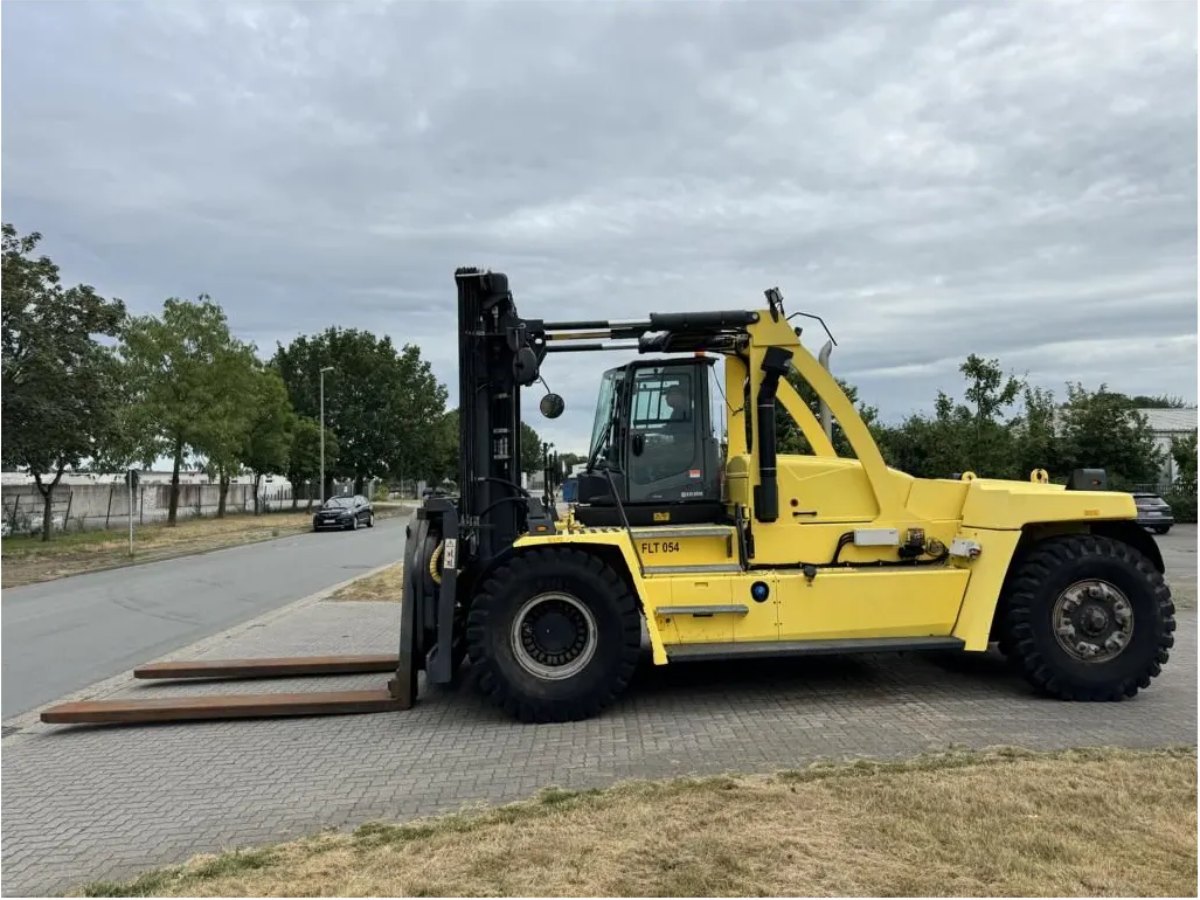
A heavy-duty forklift is not simply a large forklift, but a distinct class of machinery in its own right: it often weighs more than the load it lifts, it requires a floor that can support its weight, and it is purchased according to different criteria than a 2.5-tonne forklift for a warehouse. Anyone who bases their decision on list price and year of manufacture is likely to end up buying the wrong machine – or one that ends up in the workshop after the first year. This guide explains what matters when making a purchase: reading the load capacity correctly, understanding the load’s centre of gravity, checking the machine’s condition and selecting the right machine for the job.
When does a forklift become a heavy-duty forklift?
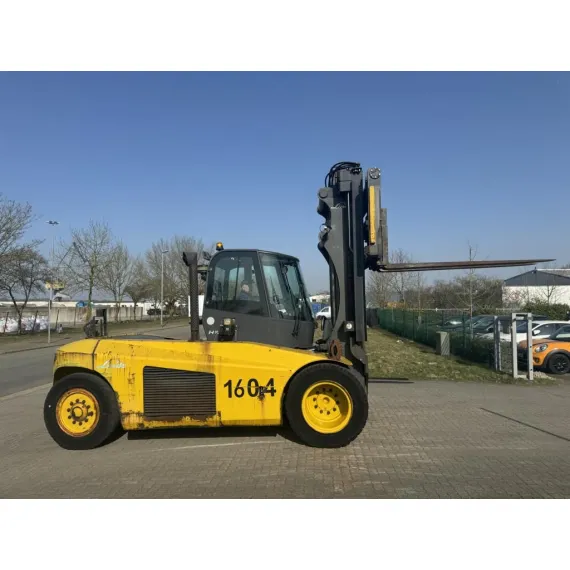 Entry-level heavy-duty model: Linde H160D, 16 t with a load centre of 1,200 mm · view listing
There is no hard and fast limit. Manufacturers start their heavy-duty ranges at 8 to 10 tonnes lifting capacity (Hyster H8–18XD, Linde from 10 t) and extend them to over 50 t – and beyond that in special designs. Typical classes: 8–12 t for the steel trade and timber, 16–25 t for heavy machinery manufacturing, precast concrete and ports, 30–50 t for steelworks, shipyards and coil handling. As the load capacity increases, so does everything else: a 50-tonne forklift truck weighs over 50 tonnes itself, the axle width can exceed four metres, and the engine power ranges from around 75 kW in the 10-tonne class to approximately 300 kW in the 50-tonne class.
Lifting capacity is only half the story: the load centre of gravity
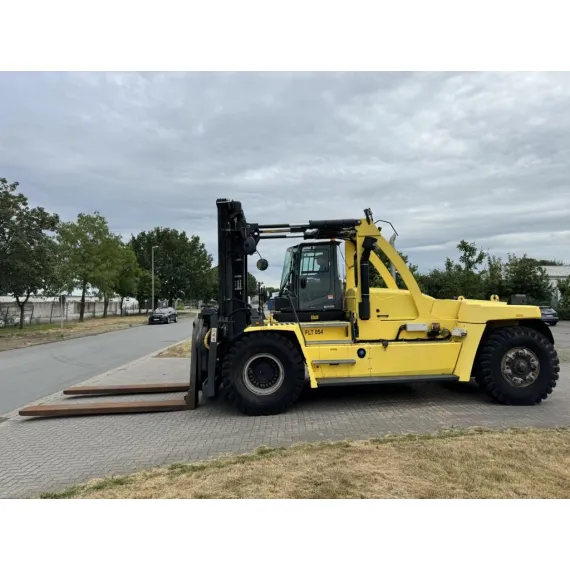 Kalmar DCG330-12: 33 t lifting capacity – valid at a load centre of 1,200 mm · view listing
The tonnage stated on the type plate always applies only to a specific load centre – the distance from the back of the forks to the centre of gravity of the load. For small forklifts, this is 500 mm; for heavy-duty forklifts, it is 600, 900 or 1,200 mm. A ‘32-tonne’ forklift with a load centre of gravity of 1,200 mm will only lift 32 t if the centre of gravity of the load is no more than 1.2 m in front of the fork back. With a wide coil, a long bundle of steel or a precast concrete element, the centre of gravity shifts further forwards – and the permissible load decreases significantly. Therefore: first measure your own load (weight, dimensions, centre of gravity), then consult the forklift’s load capacity chart. The diagram also shows what remains at full lift height and with attachments fitted – a coil mandrel, a clamp or a side shift reduce the machine’s own load-carrying capacity.
The four questions to ask before buying
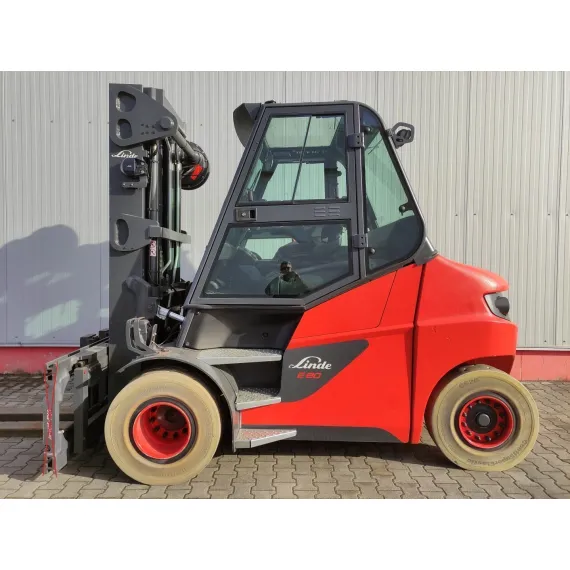 Linde E80 electric forklift truck, 8 t lifting capacity, year of manufacture 2021" width="570" height="428" loading="lazy" style="width:100%;height:auto;aspect-ratio:4/3;object-fit:cover;border-radius:6px;display:block;">
- What is the heaviest load – in real-world terms, not theoretically? Add 10–15% to that as a safety margin. A forklift operating at the limit of its load capacity travels slowly, wears out quickly and is dangerous.
- How high does it need to be lifted, and where? Lift height, overall height (warehouse door!) and free lift determine the mast design. Heavy-duty forklifts often have duplex rather than triplex masts – high load capacity and great lift height are sometimes mutually exclusive.
- Can the floor support the load? Wheel loads of 30–60 t per front wheel are normal for large machines. Warehouse floors, yard paving and ramps must be designed to cope with this – this is more often the problem than the machine itself.
- Diesel or electric? Diesel is the standard choice for outdoor use and continuous operation. Electric heavy-duty forklifts up to around 18 t are now well-established, quiet and emission-free – the better choice for indoor use, but they require a charging infrastructure and, in the case of second-hand machines, a certified battery: the drive battery can account for up to a third of the purchase price.
Buying second-hand: what to check
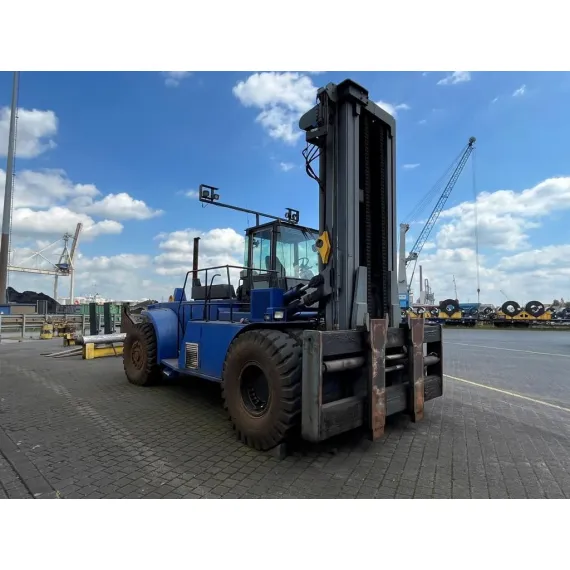 Check before buying: mast, tracks, hydraulics, tyres – here is an Hyster H32.00F (32 t) · view listing
Operating hours are the first thing to look at, but not the most important. As a guideline: up to around 1,000 hours per operating year is considered moderate use; significantly more indicates shift operation. The decisive factor is the condition of the components that really cost money on a heavy-duty forklift:
- Fork tines: According to ISO 5057, tines must be taken out of service if the thickness at the load-bearing leg or back has worn down by more than 10 per cent, the tips have a height difference of more than 3 per cent of the tine length, the angle deviates by more than 3° from 90°, or cracks are visible. On a 32-tonne forklift, a pair of forks costs a five-figure sum – it’s well worth checking.
- Mast, chains, rollers: The mast must match the type plate; all movements must be smooth, with no play between the fork carriage and the mast guide; chains must show no stretching or damage.
- Hydraulics: Run the engine for 15 minutes, operate all functions, then check for oil traces on a clean floor. Cylinders with scoring or oil seepage are expensive.
- Tyres: An often underestimated cost on large machines – a set of solid rubber or super-elastic tyres for a 25-tonne forklift costs more than some small forklifts. Check for tears, cuts, thermal deformation and the condition of the rims.
- Drivetrain: Transmission (power-shift or hydrostatic), axles, brakes, cooling system – carry out a test drive under load, not empty.
- Documentation: Up-to-date inspection report in accordance with FEM 4.004 (annual expert inspection, formerly UVV), CE marking and declaration of conformity, load capacity plate appropriate for the mast and attachment, service history.
Which machine for which task
| Task | Load capacity class | Typical machines | What matters |
|---|---|---|---|
| Steel trading, long goods, timber | 8–16 t | Kalmar DCF/DCG 80–160, Hyster H8–16XD, Linde H80–160 | Centre of gravity 600–900 mm, fork length, side shift |
| Precast concrete, mechanical engineering, port | 16–25 t | Kalmar DCG 180–250, SMV 20–25, Hyster H18–25XD | Centre of gravity 1,200 mm, floor load, overall height |
| Steelworks, shipyard, coils, containers | 30–52 t | Kalmar DCG 330, Linde H320, Hyster H32XD, SMV 45–52 | Attachments (coil mandrel, top lift), wheel loads, machine transport |
| Palletised goods up to 5 t, indoor | 1.5–5 t | Electric/diesel front-loading forklifts | No heavy-duty forklift required – electric front-loading forklifts are more cost-effective here |
Model specifications are given as examples; lifting capacity always according to the load chart at the actual centre of gravity.
Where to look
machinery-market.eu currently lists used heavy-duty forklifts ranging from 10 to over 50 t – Kalmar, Hyster, SMV, Linde, Meclift – with year of manufacture, operating hours, load capacity, lift height and photos for each machine, supplied by the specialist Hinrichs Flurfördergeräte from Oldenburg. Those looking for machines below the heavy-duty class will find a wide range of electric forklifts, diesel forklifts and reach trucks for warehouses and industrial premises at Zoch Gabelstapler (Aidenbach).
Frequently asked questions
From how many tonnes is a forklift classified as a heavy-duty forklift?
Manufacturers typically start their heavy-duty ranges at a load capacity of around 8 to 10 tonnes. At the upper end, the class extends to over 50 tonnes.
What does the load centre of gravity mean in a forklift truck?
The load centre of gravity is the distance from the back of the forks to the centre of gravity of the load; for heavy-duty forklifts, this is usually 600, 900 or 1,200 mm. The specified load capacity applies only up to this distance; if the centre of gravity is further forward, the permissible load decreases according to the load capacity chart.
How many operating hours are acceptable for a used heavy-duty forklift?
As a guideline, up to around 1,000 hours per operating year is considered moderate use. More important than the sheer number of hours is the condition of the mast, hydraulics, tyres, forks and drive system, as well as a complete service history.
When do fork tines need to be replaced?
According to ISO 5057, when the thickness has worn down by more than 10 per cent, the tips of the forks have a height difference of more than 3 per cent of the fork length, the angle deviates by more than 3° from 90°, or cracks are visible. The inspection must be carried out at least every twelve months.
Diesel or electric for heavy-duty forklifts?
Diesel is the standard choice for outdoor use and continuous operation. Electric heavy-duty forklifts up to around 18 t are the quieter, emission-free option for indoor use – with second-hand machines, the battery must be checked, as it can account for up to a third of the purchase price.
Looking for a heavy-duty forklift? Second-hand machines with lifting capacities from 10 to over 50 t from certified dealers – complete with full technical specifications and the option to enquire directly with the seller. View heavy-duty forklifts · Reach stackers · All forklifts & industrial trucks.
No posts found
Write a reviewRecent posts
- Reach stacker or container forklift? Which machine is best suited to which type of container handling?
- Buying heavy-duty forklift trucks: load capacity, centre of gravity and checking the condition of second-hand machinery
- Choosing the right construction compressors: pressure, air flow and the right machine for every job
machinery-market.eu
The European marketplace for new and used machinery, commercial vehicles and industrial equipment.
Would you like to enquire about a machine?
Please contact the seller directly via the enquiry form in the listing or via the seller profile.
© 2025 - 2026 machinery-market.eu.
machinery-market.eu — the European online marketplace for used and new machinery. On our B2B platform, you’ll find thousands of verified listings from commercial sellers across Europe in the fields of construction equipment, agricultural machinery, food processing equipment, commercial vehicles, machine tools, and specialty equipment.
Our marketplace includes the following machinery and equipment categories, among others: Excavators, mini excavators, mobile excavators, crawler excavators, compact excavators, track excavators, wheel loaders, skid-steer loaders, farm loaders, telescopic loaders, dump trucks, articulated dump trucks, articulated trucks, rollers, tandem rollers, trench rollers, vibratory plates, rammers, compaction equipment, construction compressors, power generators, light towers, aerial work platforms, scissor lifts, telescopic work platforms, forklifts, forklifts, electric forklifts, container handlers, demolition excavators, demolition hammers, drilling rigs, earth rockets, pipe layers, plow layers, snow groomers, high-pressure cleaners, dry ice blasting machines, sandblasting systems, cleaning technology.
In the field of agricultural machinery and forestry equipment: tractors, combine harvesters, forage harvesters, balers, round balers, square balers, plows, cultivators, harrows, seeders, drillers, fertilizer spreaders, field sprayers, crop protection sprayers, trailers, dump trucks, silo trucks, slurry tankers, manure spreaders, front loaders, rear loaders, wood splitters, harvesters, forwarders, forestry mulchers, sawmill machinery, wood chippers, planers.
In the field of food and packaging technology: Packaging machines, labeling machines, filling systems, bottle fillers, conveyor belts, refrigeration systems, freezing systems, baking ovens, deck ovens, cutting machines, kneading machines, dough dividers, mixers, vacuum packaging machines, shrink tunnels, palletizers, robotic cells, CIP systems, pasteurizers.
In the field of machine tools, CNC, and metalworking: CNC lathes, CNC milling machines, machining centers, 5-axis machines, turning centers, grinding machines, cylindrical grinders, surface grinders, drilling machines, column drills, sawing machines, band saws, plasma cutters, laser cutting systems, waterjet systems, press brakes, shear machines, edge grinders, welding robots, robotic cells, 3D printers, generators.
In the commercial vehicles and transport sector: trucks, tractor-trailers, semi-trailers, trailers, low-loaders, dump trucks, refrigerated trucks, garbage trucks, vacuum excavators, vacuum trucks, flatbed trucks, box trucks, pickups, flatbed tarps, containers, swap bodies, roll-off dumpers, skip loaders, water trucks, spray trucks.
We facilitate business transactions in the following sectors: civil engineering, building construction, road construction, earthworks, demolition, recycling, landscaping, gardening and landscaping, agriculture and forestry, logistics, industry, metal construction, wood processing, food production, food processing, packaging industry, printing industry, pharmaceutical industry, construction companies, equipment rental, rental parks, workshop supplies, and blow-in technology.
Our listings reach buyers and sellers from Germany, including the following cities and regions: Berlin, Hamburg, Munich, Cologne, Frankfurt am Main, Stuttgart, Düsseldorf, Leipzig, Dortmund, Essen, Bremen, Dresden, Hanover, Nuremberg, Duisburg, Bochum, Wuppertal, Bielefeld, Bonn, Münster, Karlsruhe, Mannheim, Augsburg, Wiesbaden, Mönchengladbach, Gelsenkirchen, Aachen, Braunschweig, Chemnitz, Kiel, Halle (Saale), Magdeburg, Krefeld, Freiburg im Breisgau, Lübeck, Mainz, Erfurt, Oberhausen, Rostock, Kassel, Hagen, Saarbrücken, Hamm, Mülheim an der Ruhr, Ludwigshafen, Leverkusen, Oldenburg, Osnabrück, Solingen, Heidelberg, Herne, Neuss, Regensburg, Darmstadt, Paderborn, Würzburg, Ingolstadt, Heilbronn, Pforzheim, Göttingen, Bottrop, Reutlingen, Koblenz, Bremerhaven, Recklinghausen, Bergisch Gladbach, Jena, Trier, Erlangen, Moers, Siegen, Hildesheim, Salzgitter, Cottbus, Speyer, Hanhofen, Frankenthal, Kaiserslautern, Landau, Worms, Germersheim, Bad Dürkheim, Neustadt an der Weinstraße, Pirmasens, Zweibrücken, Bingen am Rhein.
Active throughout Europe—including in Austria (Vienna, Salzburg, Graz, Linz, Innsbruck, Klagenfurt), Switzerland (Zurich, Bern, Basel, Geneva, Lausanne, Lucerne, St. Gallen), the Netherlands (Amsterdam, Rotterdam, The Hague, Utrecht, Eindhoven, Tilburg, Groningen), Belgium (Brussels, Antwerp, Ghent, Liège, Bruges, Namur, Charleroi), Luxembourg (Luxembourg City, Esch-sur-Alzette), France (Paris, Marseille, Lyon, Toulouse, Nice, Nantes, Strasbourg, Bordeaux, Lille, Rennes, Le Havre), Italy (Rome, Milan, Naples, Turin, Palermo, Genoa, Bologna, Florence, Bari, Catania, Verona, Venice, Trieste, Padua, Brescia), Spain (Madrid, Barcelona, Valencia, Seville, Zaragoza, Málaga, Bilbao, Murcia, Granada, Alicante, Vigo), Portugal (Lisbon, Porto, Coimbra, Braga, Faro), Poland (Warsaw, Kraków, Łódź, Wrocław, Poznań, Gdańsk, Szczecin, Lublin, Katowice), the Czech Republic (Prague, Brno, Ostrava, Plzeň, Liberec), Slovakia (Bratislava, Košice, Žilina, Nitra), Hungary (Budapest, Debrecen, Szeged, Miskolc, Pécs, Győr), Slovenia (Ljubljana, Maribor, Celje), Croatia (Zagreb, Split, Rijeka, Osijek, Zadar), Romania (Bucharest, Cluj-Napoca, Iași, Timișoara, Constanța, Craiova, Brașov), Bulgaria (Sofia, Plovdiv, Varna, Burgas, Russe), Greece (Athens, Thessaloniki, Patras, Heraklion), Denmark (Copenhagen, Aarhus, Odense, Aalborg), Sweden (Stockholm, Gothenburg, Malmö, Uppsala, Västerås, Örebro), Norway (Oslo, Bergen, Stavanger, Trondheim, Drammen), Finland (Helsinki, Tampere, Turku, Oulu, Espoo), Estonia (Tallinn, Tartu, Narva), Latvia (Riga, Daugavpils, Liepāja), Lithuania (Vilnius, Kaunas, Klaipėda), Ireland (Dublin, Cork, Limerick, Galway), and the United Kingdom (London, Birmingham, Manchester, Glasgow, Liverpool, Leeds, Edinburgh, Cardiff, Belfast, Sheffield, Bristol).
* Unless otherwise stated, all prices are in euros plus the applicable statutory value-added tax. machinery-market.eu acts exclusively as an intermediary for businesses as defined in Section 14 of the German Civil Code (BGB), government agencies, and religious and social institutions. The purchase contract is concluded directly between the seller and the buyer—we act solely as an intermediary.